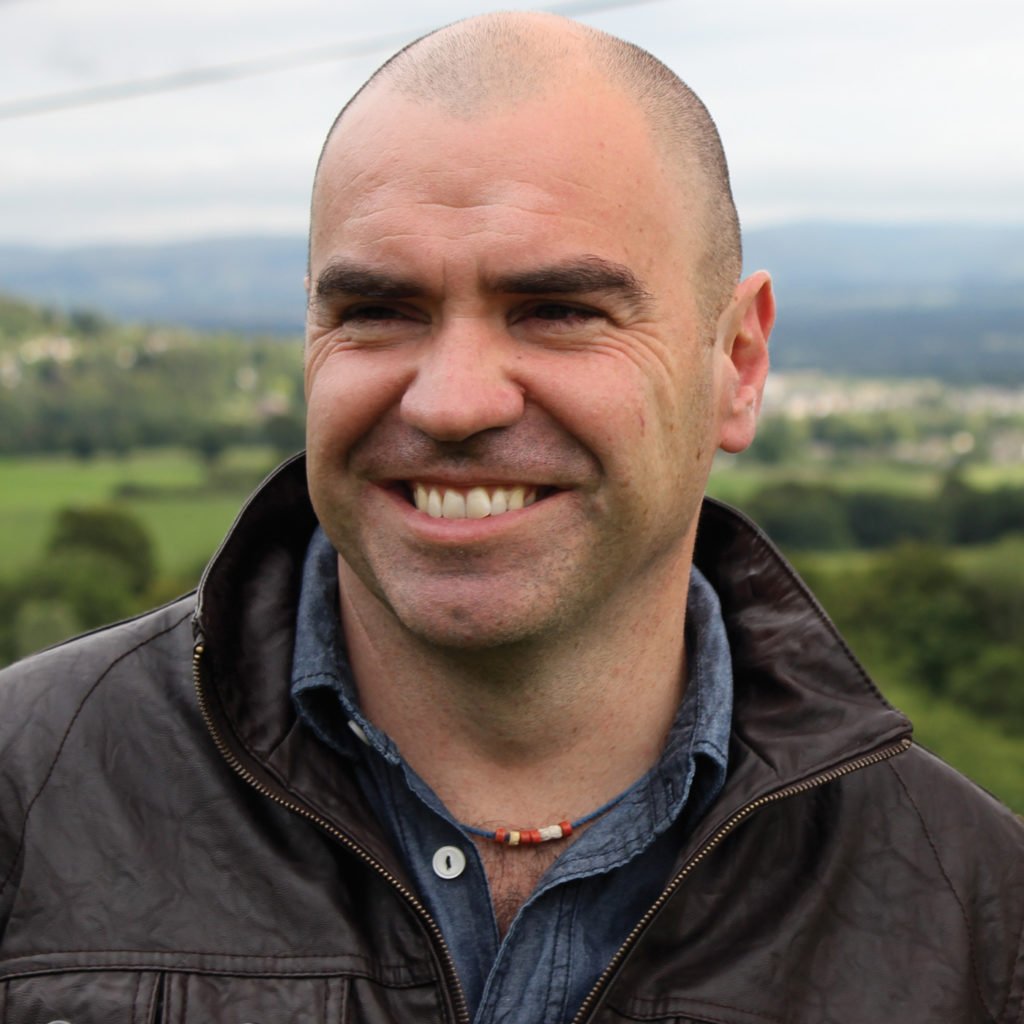
What is the mystery of old vines?” Toni Bodenstein asks, kneeling in the snow next to a skinny centenarian in Ried Zwerithaler. He and his son, Robert, farm an acre of vines planted in 1907 by the monks of Melk, who were based in the 11th-century baroque abbey high on a hill 15 miles upriver. There were twice as many plants then, Bodenstein explains, each trained to an individual post in traditional Stockkultur, their arrangement somewhat random, and a horse could not pass through.
“Dort wo ein Pflug kann geh’n, soll kein Rebstock stehen—There where you can plow, a vine is not allowed,” he said, translating an old saw of Austrian growers. “They planted 15,000 vines per hectare. Then, at the end of the 1950s, they changed the drainage system and cut away half the vines so a tractor could come through.”
“You can be sure that these vines were not bred by special breeders,” he says, noting that these breeders came into vogue in the 1940s, with “a special idea: to make a selection for quantity, for bigger berries, more sugar production. All of these things were considered better in the eyes of the breeders.”
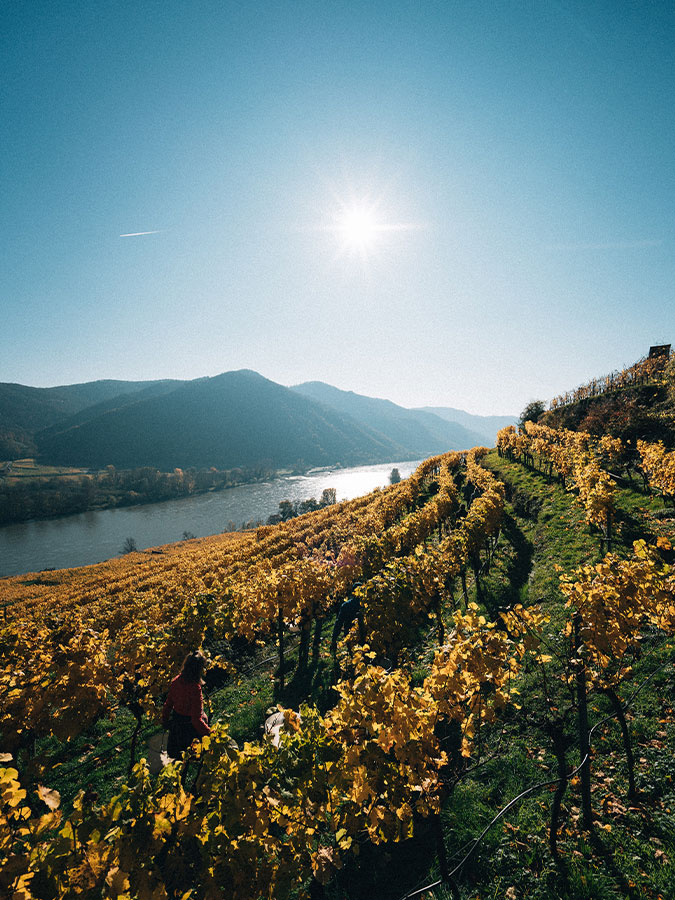
“Now we need the old genetic types to defend against climate change. These old vines produce lower yields, smaller berries, with thicker skins and lower sugar production. Because of the thicker skins, they don’t respire as much water and are not as sensitive to UV radiation.” Bodenstein finds that the 1907 vines at his Kammergut parcel in Zwerithaler are “very steady on their quality output despite vintage variation.” In a shifting climate, that consistency alone demonstrated how old vines are better adapted to climate change. Among Prager’s other old-vine bottlings, the Achleiten Riesling Smaragd comes from vines planted in the early 1950s; the vines for his Achleiten Stockkultur Grüner Veltiner Smaragd date to 1937. Rather than delivering blunt power in their fruit and alcohol, these wines employ the more subtle power of soil expression, providing layers of savory detail.
“The same variety on the same rootstock in the same parcel will have different aromas depending on age,” Bodenstein has found. “Young vines tend to produce more fruity characters, where as old vines tend to produce more different aromas instead of a pure fruity character. This is mostly due to a higher concentration (which, in return, results from the usually lower yield from old vines). Wine from old vines will usually have a more nuanced character with some ‘salty’ aspects, more extract and less fruit.”
He cites several other advantages his old vines have as they face down extremes in climate. One may be a greater protection from frost damage, given their higher percentage of old wood. When the cells of old vines contain a higher concentration of sugars and micronutrients, they freeze at lower temperatures. (“Pure water will freeze at zero degrees Centigrade, while water with a higher concentration of minerals—potassium, sodium, etc.—will freeze at lower temperatures.”) For old vines, this concentration is facilitated by a well-established root system in collaboration with the mycorrhizal network in the soil. He also believes that the cells of old vines have a different enzymatic structure, drawing a parallel to humans—how most babies live on milk, while, with age, many people can’t digest it. “Is there a change in the vines with age in terms of what proteins they produce? It is still not known.”
Bodenstein isn’t posing mystical questions. Nor does he conflate science and industrialization. He’s taking a pragmatic view of old vines, using science to understand the natural world, and bringing his formidable intelligence to the questions that need to be asked.
Of the 110,000 acres of vines in Austria, 5,935 are more than 50 years old, with 44.5 acres recorded as more than 100 years old.
Marco Simonit is a different kind of old-vine pragmatist. This past winter, the agronomist from Friuli came to Austria’s Alpine village of Lech to talk old vines. It’s an unlikely place for a vineyard discussion, at 4,738 feet in altitude, where the sky had just dumped six feet of snow.
Austrian winemakers come to Lech to visit the community of restaurants that has taken root here, with deep cellars that compete to attract a wealthy international clientele. A prime time to visit is during Arlberg Weinberg, a wine festival in mid-December that got its start as winemakers would descend on the village pre-season for some skiing and selling. And so, Marco Simonit, some of his clients, and some would-be clients found themselves this December in a conference room at the Gasthof Post.
Simonit built his farming philosophy out of years of observation to understand what he could about the worldview of a vine. That philosophy informs his work as a pruning consultant; with his business partner, Pierpaolo Sirch, he trains vineyard teams in “soft pruning” techniques, helping to extend the life expectancy of vines that produce some of the world’s most coveted wines.
A vine wants to grow, he asserts. Which means that most people who spend their time cultivating vineyards battle that reality everyday. There’s something unruly about letting a vine crawl along the ground in search of a tree to climb, to drape that tree with its leaves and its fruit and, perhaps, eventually smother its own support.

“Humans need vines, but the vines don’t need the humans.” —Marco Simonit + Sirch
Growers set the rules for the plants in their care, their aesthetics of control on display in the baskets of assyrtiko vines on Santorini, the bush vines of Barossa, the guyots of Bordeaux or the vertical shoot positioning that had become, until recently, a tradition in Napa Valley.
Marco Simonit doesn’t care how growers choose to train their vines—as bushes, on a trellis or a pergola. What matters to him and, he believes, to the vine, is how you cut it. In partnership with Pierpaolo Sirch, he has built a consultancy that now touches vines at a range of privileged sites, from Latour in Pauillac to Cathy Corison in St. Helena and Louis Roederer in Champagne. He is part of a movement instigated by François Dal, viticulturist at SICAVAC, the interprofessional consulting service for the Central Loire, working in agronomy, vinification and analysis. Recently, Dal came to the Tasting Climate Change conference in Montreal to give a presentation; during a break, I asked him how he had developed his pruning technique.
Dal had started his career in Champagne, where he saw a bit of vine mortality due to trunk disease; in some parcels in Sancerre, he was surprised by the large number of vines dying each year, rotting from the inside. “Speaking with wine growers, we talked about fungi going into the pruning cuts and creating dead wood, but that didn’t correspond to what I observed.” Some vineyards had a lot of disease, others very little, and all were being pruned. “It was clear the way of managing the vineyard had a big impact.”
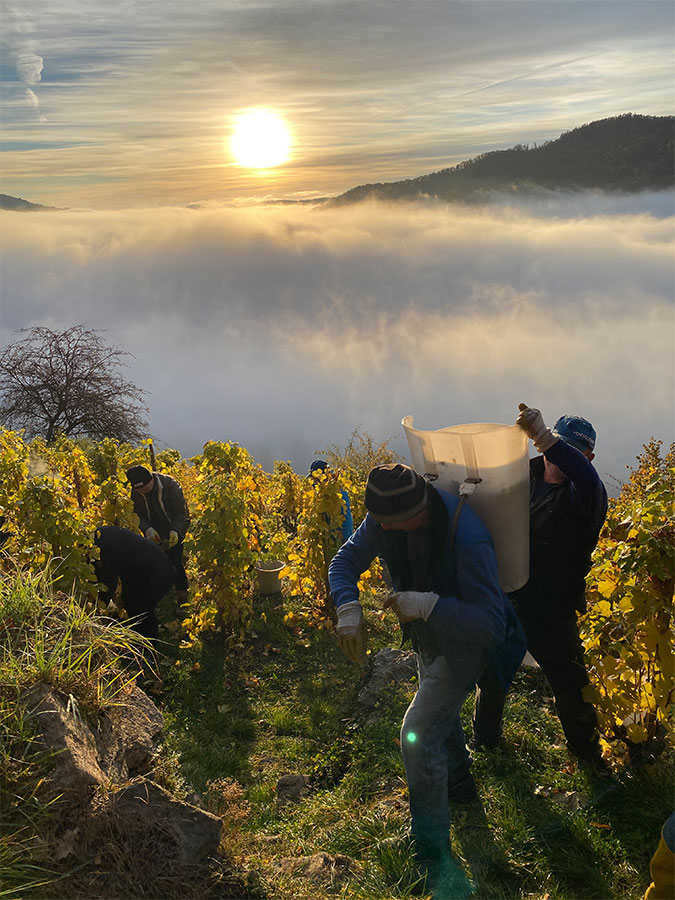
In 2003, a year into his tenure at SICAVAC, Dal recalls helping a grower convert his vines from guyot (or cane) pruning to cordon pruning (establishing two arms off the trunk of the vine, with short fruiting canes). “I had taken the two cordons from one side of the trunk and one of his workers, going into retirement at the end of the week, told me I should not do it that way. He said the other side would die. I felt really stupid because it was so obvious.”
Intrigued by what he hadn’t considered before, Dal started to study the interior of the vines, cutting them horizontally and longitudinally to study the process of how the wood was dying. “I cut younger and younger vines and began to understand that the fungus was not causing the dead wood, but came in when the dead wood was present. It was obvious that the pruning was the most important way to manage the dead wood.”
A year later, he read about the work of Eugène Poussard in a technical review in France. Poussard, a viticulturist in Cognac at the turn of the 20th century, conducted early experiments on the effects of pruning on trunk disease (esca). He developed pruning practices to mitigate those effects, which René Lafon detailed in a book in 1921 (recently, it was translated into English, as Changes to be Made to Vine Pruning, in Order to Minimize Vine Disease & Decline [Ex Vinum, 2023]).
“I found the book in December of 2005—it was my gift for Christmas.” The book confirmed what Dal had been telling growers for the past year—knowledge that had been lost post–World War II, when vine growers bought tractors and rearranged their plants to mechanize their work. Then pneumatic pruning shears came along to speed the process, while the training of vines to straight trellised rows became standard practice. In the business of vineyards, vines are a production unit; vineyard workers fit the vine to the architecture of the trellis. (Time is money, and when applications of arsenic were discovered to help prevent esca, the damage of pruning could be mitigated by chemicals. Today, due to arsenic’s toxicity, that is no longer an accepted option.)
A century after Poussard’s work, Dal started calling his pruning method “Guyot Poussard,” and wrote a book in 2008 to help growers prevent vines rotting from within, as fungi and diseases enter deadwood pathways of their pruning cuts. His book is now in its second edition: Bons Pratiques de Taille et Techniques Curatives Contre les Maladiesdu Bois (published in 2022 by SICAVAC and the BIVC, the interprofessional bureau for wines of the Central Loire).
Dal connected with Marco Simonit in 2011, visiting in Friuli to help train his team. Meanwhile, back in the Central Loire, Dal reports that, 20 years ago, there was four percent mortality in the sauvignon blanc vines each year. “Nowadays, most growers who apply these techniques are under 1.5 percent, some under one percent.” At a time when old vines may turn out to be significantly more resilient to radical shifts in the climate, careful, thoughtful pruning is one powerful tool for their survival.
“I cut younger and younger vines and began to understand that the fungus was not causing the dead wood, but came in when the dead wood was present. It was obvious that the pruning was the most important way to manage the dead wood.” —François Dal, SICAVAC
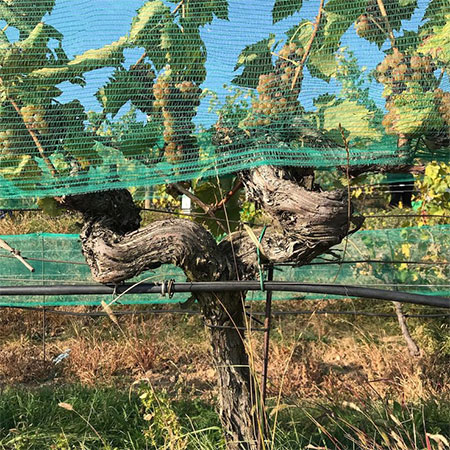
Humans need vines,” Simonit says to the gathering in Lech, “but the vines don’t need the humans. Farming becomes dangerous for the vines, especially if you want to have good aging for the vine.” Dressed for work, in a flannel shirt and tattered blue jeans, he’s broken with the carefully tended couture of the Gasthof Post in Lech, an Alpine ski destination for wealthy Europeans. There are no vineyards nearby, but if you were to follow the Lech River to its confluence with the Danube, you would head east, passing plenty of vines as you closed in on Vienna, many of them 40, 60, 80 or 100 years of age and older. Growers along the way have hired Simonit & Sirch to train their vineyard teams, in an effort to sustain their old vines.
The teams learn how to think before they cut, how to bring a surgeon’s care to tending their vines, taming the feral nature of a vine while sustaining its healthy sap flow. Simonit seeks to avoid cutting into the arteries of the vine’s vascular system; he considers the xylem and phloem, the water and nutrient pathways through wood. In his pruning cuts, he leaves enough distance from that healthy wood so that the vine can heal.
Pruning creates deadwood, which the vine can handle as long as the scarring does not block the sap flow through the healthy wood. Simonit leaves a distance of twice the diameter of the cut, so the desiccation of the wood stops before it reaches the vascular system supporting the cordon or trunk of the vine. If the cut is too close to the healthy wood’s sap flow, the deadwood forms what Simonit calls a “desiccation cone;” that deadwood not only restricts the sap flow, weakening the vine, but it also creates an open wound pointed at the plant’s core. His team trains growers to consider the architecture of each vine individually, to strategize the preservation of healthy wood based on the structure of that particular vine.
A healthy vine, without a vein of fungus rotting its core, is more resistant to disease and pests, and more likely to live into a long maturity. How long? Some vines die in ten or twenty years, depending on when pests attack their roots (as in, phylloxera) or their sap (glassy-winged sharpshooters drinking from the plant’s xylem and leaving a bacterium behind, aka Pierce’s disease). If they do survive for forty years, they may be worn down by the annual pruning cuts that have expanded into large wounds, pathways for fungi to hollow them out. A healthy vine at 60 will have a large network of roots, with plenty of carbon storage in its wood to sustain it through challenging moments (like climate extremes), and, though it may not have the vigor of a young vine to produce a lot of reproductive fruit, it tends to yield a more even crop from year to year with fewer grapes. Outside of any aesthetic, romantic or philosophical justifications for sustaining those vines past 40, 60, 80 or 100 years, growers might find the yields sufficient to sustain their business model, given the depth of detailed flavor in the wines that some, though not all, old-vine fruit produces.

“Now we need the old genetic types to defend against climate change. These old vines produce lower yields, smaller berries, with thicker skins, they don’t respire as much water and are not as sensitive to UV radiation.” —Toni Bodenstein, Weingut Prager
While young vines can be trained to produce grapes for richly fruity wines, a style well appreciated in the contemporary market, old vines have a different talent. When farmed for long life, a vine’s root system develops into the web of microbial and fungal life in the soil, a symbiotic network of relationships that help deliver and exchange nutrition—minerals fed into the roots, sugars fed to the mycorrhizal fungi. It’s the opposite of industrial farming, in which the soil is a place for the vine to stand, while nutrients and pest protection are delivered from above. Soil, in fact, can act as a vast carbon sink when farmed to sustain its biodiversity. In one of the most fascinating presentations at the same Tasting Climate Change conference, Marc-André Selosse outlined the benefits of no-till farming, as well as the damage tilling can cause, compromising the life of bacteria and fungi underground, often leading to desertification, as the organic matter storing carbon turns to sand. He also pointed to another benefit of old vines—that roots store 10 to 40 percent of the photosynthesis of the plant, and that soil captures as much carbon from the dead roots of vines as from the dead leaves they drop each year. In a changing climate, with water availability at a premium for vine growers, Selosse made the point that water sluices through dead soils, while living soils store water, making it accessible to the roots of vines.
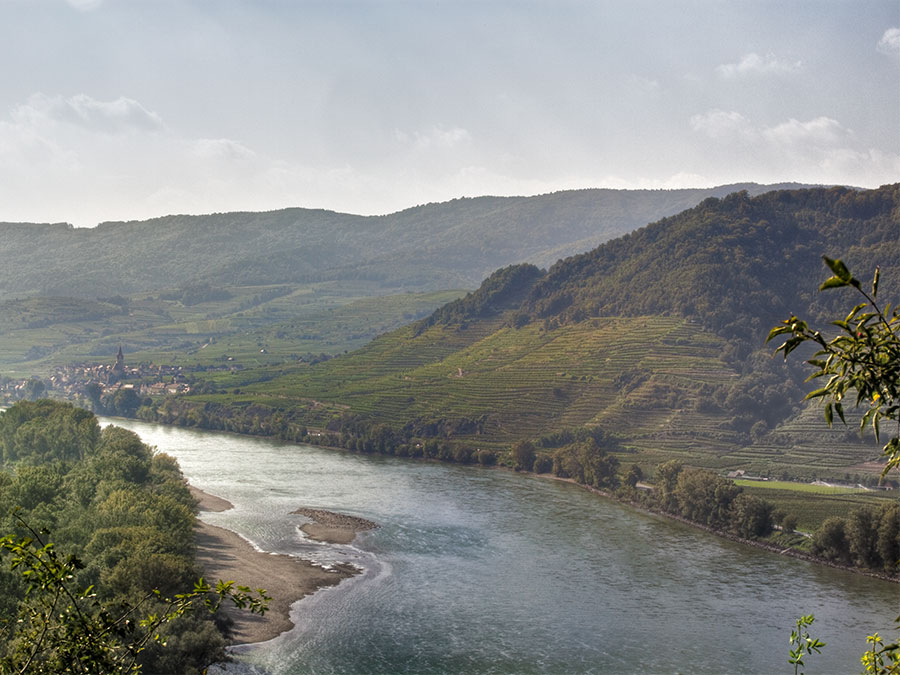
As the snow melts into the Lech River, it might take days, even weeks, for a drop of water to flow down to the Danube, and then on past the Wachau’s vinelands that rise on either side of its banks. That snowmelt has sometimes been epic, flooding the river towns that huddle along those banks. In 2002, a historic Central European flood was one of the most extreme in recorded history, 800 years after the first written records of the house and ship mill where Prager’s cellars are now based, by a small stream, the Ritzlingbach, as it flows into the Danube. Today, there’s a riverside restaurant just across the road, Heinzle, where Toni Bodenstein regularly brings visiting guests, and almost always orders the Bürgermeister Forcelle, a whole small salmon roasted with potatoes; it became “the mayor’s forcelle” during his tenure as bürgermeister of Weissenkirchen.
“In 1991, we had a lot of water in the winery,” Bodenstein recalls, forcing him and his wife, Sophie Prager, to abandon the ground floor of their house. “It was terrible for my wife,” he says, describing how Sophie and their one-year-old son, Robert, were living upstairs without a kitchen. When two floods came in 2002—“one in June, one in August; the water was more than ten meters high”—Bodenstein was two years into his first term as mayor. “The government wanted to build dams and a permanent wall, destroying the landscape,” he says, mentioning a presentation by the government’s architect that got very heated. “I started a fight against the government—a really big fight. I said, ‘If we are to work to protect from the floods, we need to protect the landscape as well. It’s a world heritage.’ And they said, ‘Okay, then try doing it yourself.’” Which he did, and Weissenkirschen became the first town to build a flood wall in the Wachau. It was still under construction in 2009, when another major flood arrived, but missed breaching the wall. By 2013, the wall was in place for the biggest flood since the 1880s. “The pressure was getting so high on the flood walls that half the town needed to be evacuated,” Bodenstein says, but the walls held.
On the surface, especially on the river terraces, the floods are one significant factor in soil formations. Wind is another, blowing sand and loess down the river valley from the west, leaving deposits on the eastern sides of the hills. The hills themselves combine the rock from three continents, along with ancient seabeds, volcanic uplifts and slow erosion, leaving several layers of mother rock. Back at the Prager home and winery, Bodenstein has more than a dozen of these soil profiles framed into full-scale displays. Soil, in fact, seems to be the factor that most excites him about his work in wine; that is, almost as much as the microbial life in the soil, or underground mycorrhizal networks that he seeks never to disturb, or vine genetics, which he has been studying at Wachstum Bodenstein, his highest vineyard (an elevation of 1,500 feet), planted in 1990 to a wide range of riesling selections.
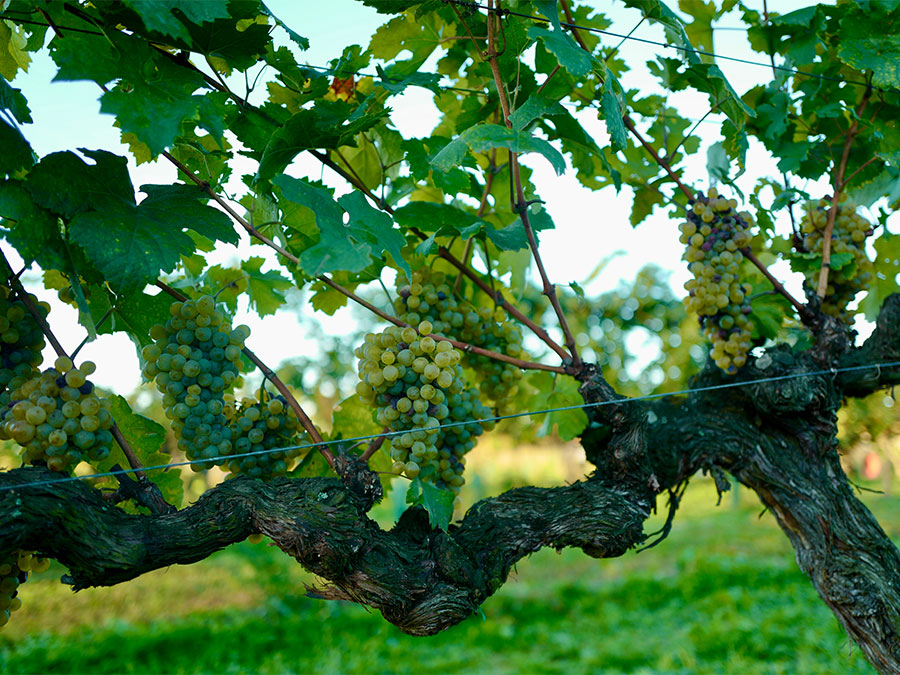
“You have to treat vines in a good way so they have the possibility to get old,” Alwin Jurtschitsch says outside the stone hut he built for his vineyard team. He has used all the varied rocks of Heiligenstein in its construction, including the reddish desert sandstone, the soil at Ried Steinwand, on the western side of Heiligenstein, where the hut overlooks the Danube far below.
Jurtschitsch is dressed in a heavy parka, his long hair tucked into a woolen ski hat. Snow has blanketed the terraces and settled on the vines, piling up along the twists of their cordons. Close to the top of Heiligenstein, these vines had been abandoned until Jurtschitsch set out to resuscitate them. The higher up the hill, the more likely it is that a grower gave up on a parcel. Even at the top, within the forest, there are pockets of vines on what is now the forest floor.
“A biologist and trail runner found an old vineyard in the forest,” Jurtschitsch tells me, looking up toward the top of the ridge. “There were huge trees growing in the terraces—the trees were probably eighty years old. And there were still vines there, but they were too shaded to give fruit.” Jurtschitsch dug one out, planted it in front of his house in a bed of compost and it sent out a shoot this year. As for his own collection of old vines, he found them by biking or jogging along the terraced hillside. “When I saw a vineyard that wasn’t being pruned anymore, I would ask about it. That’s how I was able to buy my first vineyard in Heiligenstein.” After negotiating that first parcel in 2007, he eventually found three other owners willing to sell to him.
The parcels are new to the family estate, which dates to 1868, and to the cellars, which date to the 14th century. Alwin’s wife, Stephanie Hasselbach, handles winemaking—she grew up at her family’s Gunderloch estate in Germany’s Rheinhessen. Through his work abroad—on the compost crew at a biodynamic farm in Australia in 2001 and, later, in 2005, during a stint at Matassa in the Roussillon with Stephanie—Alwin had developed certain convictions about farming. The first was that he had to convert his family’s estate to organics. Another was that he wanted to dry farm his old vines. “My father told me, ‘If you shut off the water, I will shut off the money.’” So, instead, he installed a switch on every irrigation line, to deliver water only where it is needed. “I don’t want to get stuck in tradition,” he says. “I want to look forward.”
He and his team have learned to do a careful calculation during the pruning season, to set their yields for 5,000 kilograms per hectare. Seeking that balance when he converted the vines to organics led Jurtschitsch to Marco Simonit, whom he visited more than a decade ago with a group of Austrian winegrowers. “His customers’ vineyards looked so beautiful, and he showed us all the system of his pruning.” Simonit & Sirch were soon training the Jurtschitsch team.
“When you work with the Simonit guys, you have to use the same vineyard team every year,” he says. They have to be able to see how their work from the previous year played out. “In the past, pruning was not the sexiest work to do, and the team was not getting a lot of attention. But the pruning sets the baseline. Simonit taught us to read the vine, to build a personal relationship. Changing the pruning changed the culture of our team: They wanted to work the same rows as the year before, because they began to recognize the vines. They would ask each other questions and share ideas about cuts. We put away out pneumatic pruners and worked by hand—we learned to make the cuts. Now, we can use the pneumatic pruners more carefully.”
The detailed farming shows up in the detail of the Jurtschitsch wines. Alwin and Stephanie’s 2021 Heiligenstein Alte Reben Riesling came in at 12.5 percent alcohol with no botrytis. “You cannot make a spontaneous fermentation with botrytized grapes without using sulfur, so botrytis does not work in our cellar,” Jurtschitsch says. He grows one third of this fruit at Steinwand, the western face of the hill, where the rock has been exposed by winds blasting from the Alps; one third at the center of Heiligenstein; and one third in Rotfels, where the hill bends to the northeast, an eddy for the winds where loess has collected over the ages. The wine’s potent aroma seems to parallel the dark earth tones of the desert sandstone. Next, he pours the 2021 from Steinwand and suggests that, in the future, the Alte Reben bottling may go away, replaced by individual sites. The Steinwand Riesling ups the mineral intensity, while freshness buzzes through it—the site has a wide diurnal shift in temperature. That freshness brings an umami compression, layering scents of flower petals and herbs. The fruit of Jurtschitsch’s old vines gives the wine a fleshy presence without any sense of fruitiness, just a sensation that’s crisp, crunchy and mouthwatering.
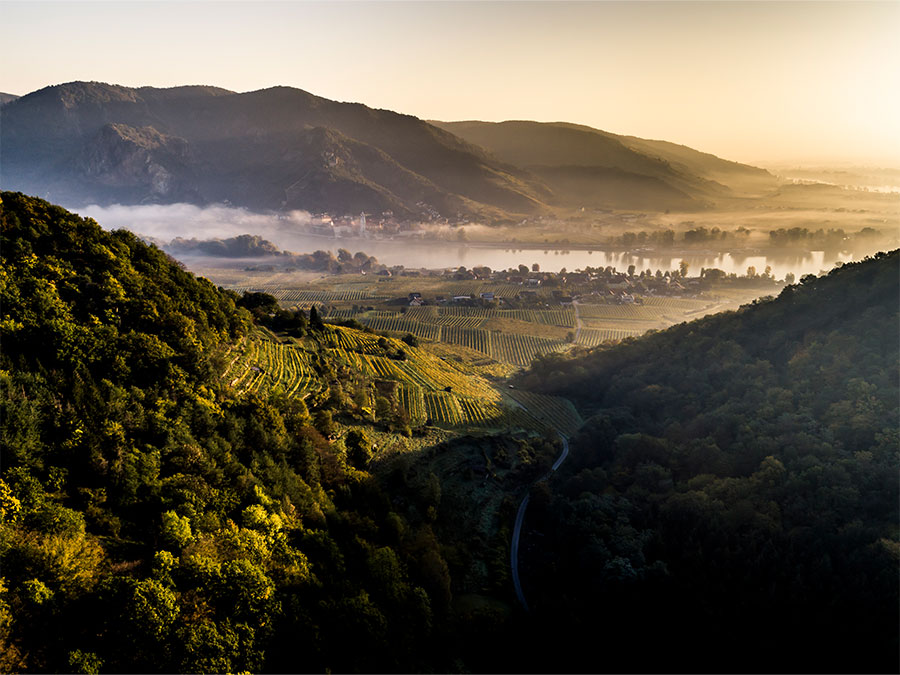
Willi Bründlmayer called out the importance of old vines as far back as 1988, when he first added the Alte Reben designation to his Heiligenstein Riesling—a term now widely used throughout lower Austria. At his cellars in Langenlois, he shared a bottle of the 1994, still firm, juicy, deeply savory, its casual elegance and mineral spice carrying a lasting freshness, a sort of dried-pineapple flavor you can breathe for long after each taste.
“In the poor, rocky soils of Steinwald, the riesling vines survive, but they don’t produce wood anymore—they remain skinny,” Bründlmayer explained. He and Andreas Wickkoff, MW, who joined as the estate’s general manager in 2016, are actively working to promote the longevity of their vines. They showed me some of the vines they have been trying to save, where fungus, having entered through an old pruning wound, had killed the core of the trunk. They have worked with the team at Simonit & Sirch since 2014, learning to wield small chainsaws, carefully chiseling out the dead wood, leaving a vine with a trunk that looks like a scroll. The live wood at the edges of the trunk still fosters sap flow, engaging the leaves with the roots and the networks of life below ground. “If we take out the deadwood from esca, then, hopefully, the sap flow will bring back energy,” Wickkoff explained. “We have three pruners doing this, and our success rate is between 70 and 75 percent.” At first, he estimates, it took each pruner 50 minutes per vine to clean up the virused wood; now, they are down to about 15 minutes per vine.
There are pockets of old vines across the river, including at a steep, rocky site farmed by Georg Frischengruber. He makes wines from the family’s vines, while his brother, Heinz, is the winemaker at Domäne Wachau, the local cooperative. His great-grandfather built the terraces at the family’s Goldberg vineyard, across from the castle at Durnstein. And, even after Georg’s grandfather rebuilt them, they were not tractor-friendly. Their narrow passages have proven to be challenging—Georg fell with his tractor in 2020 and he was sidelined in the hospital.
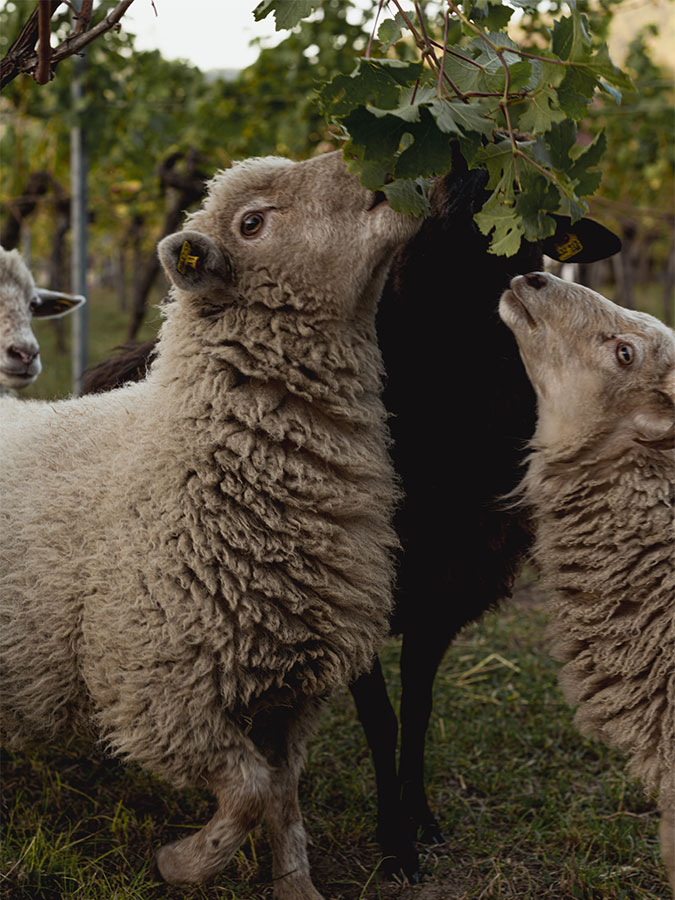
But he is back, shepherding a team of six small sheep who help him tend the grasses between the vines. “We start after the harvest at our farthest western block, leaving the sheep in each parcel for about three weeks,” Frischengruber says, explaining that they not only take care of the over-eager grasses; by digesting those grasses, they also supply much needed nutrients to the heavy granite soils.
Frischengruber’s estate earned Lacon certification for organic farming in 2019. “My goal was not to extend the life of the vine,” he says, “but to protect the entire ecological system of the vineyard. After the first year we had many more insects and creatures in the vineyard again. Slowly, many types of wildflowers and herbs also arrived. The idea is to get healthy grapes but at the same time to give something back to the soil and nature, so that this system can continue to run for as long as possible and my daughter can also use it.”
“Of course, the vines also benefit,” Frischengruber says, having noticed that the riesling berries at Goldberg are now smaller with thicker, more flavorful skins. Ripening through the sunny mornings of 2022, the Goldberg Riesling Smaragd came in at 13 percent alcohol and 8.8 grams per liter of total acidity. When he pours it at the winery, the wine delivers a floral, dry, stony intensity, an indelible impression of Goldberg’s steep terraces that seems to vibrate with pent up energy in the end.
Joshua Greene is the editor and publisher of Wine & Spirits magazine.
Related Stories:
This story appears in the print issue of Spring 2024.
Like what you read? Subscribe today.