Once an acquired taste, skin-contact wines have become such a hot category that buyers can’t keep them in stock. Eric Harris of Mateo Tapas in Durham, NC, told us, “Where I worked ten years ago, we had one orange wine on our list, and I realized that we’d only opened three bottles over two months. Now we sell cases of skin-contact whites in a week. It’s still a little wild to me.”
Kylie Monagan, a partner in Calissa, in the Hamptons, told us an especially vivid story about orange wine: “When we opened in 2017,” she says,“we had three different types of wines on our list—‘Greeks, Geeks, and Grandmas.’ It was Greek wine, geeky wine, and then ‘Grandmas,’ like Kistler, etc. Early on, to our sort of dismay, the Grandma category was selling, and the geek category shrank. I kept a few on, certain producers that were really important to us, but pulled back.
“Then, I don’t know what it was—maybe because our audience has been younger in the past two years—I put a couple of Greek orange wines on the list. And we sold out of them in a weekend. I said, ‘Wow, that’s crazy.’ I brought them back, and we sold out of all of them again.
“Then one day I was tasting these wines with one of our partners, Nicola Kotsoni, who grew up in Greece, on the island of Zakynthos. She’s super well-traveled, has amazing taste, and I thought, ‘She’s probably not going to like these, they’re kind of weird.’ But she said, ‘This is how my grandmother used to make wine, and everyone in her village. This is what wine used to taste like in Greece.’ I thought that was really cool.” Suddenly she had Greek wine, geek wine and Grandma wine, all in one bottle.
This story crystallizes the appeal of orange wine in 2023: a trend and a tradition, a wine for geeks and for grandmas. Part of its appeal, said buyers, stems from the fact that as the category has expanded, so has its stylistic expression. “Producers are finding that they can produce skin-contact white wines that are a little more accessible,” says Ksandek Podbielski, an owner of Coquine, in Portland, OR. “They’re not necessarily all about tannin extraction and umami, but can still possess freshness and are thirst-quenching. That’s been a cool evolution of the category.”

“Skin-contact now has a range, in the same way that red and white wines have a range. There are delicate, very pretty wines, and really wild, assertive wines, and everything in between.” —Ksandek Podbielski, Coquine (Portland)
That range is something Nicole Dougherty of Tabula Rasa in Hollywood, CA, leans on when introducing her guests to the category. “We always have at least one wine that the staff calls ‘the gateway orange,’” she says, “something that’s super-clean and approachable. If someone’s on the fence, we’ll start them with a splash and see if they like it; then we can graduate them toward something more serious or robust or wild.” The wilder ones, she adds, often come with the most interesting stories. “These are some of the oldest winemaking processes in the world,” says Dougherty. “There’s something really cool about turning people on to a beverage that’s been made the same way for hundreds of years all over the world.”
The category has also revived interest in grape varieties that once languished. “People think of gewurztraminer and pinot gris as white,” says Justin Vann of Nancy’s Hustle in Houston, “but the grapes are pink—[the must] turns this electric grapefruit color. Is it an orange wine? Is it a rosé?The answer is ‘yes.’”
For Vann, it’s brought gewurztraminer back to life as a category. “Consumers don’t love gewurztraminer,” he says. “It has no acid, it has a viscous texture, it’s hard to pronounce…but when you macerate it, it becomes 100 percent better: tannins, wild fruit flavor, balance. We are missing out on what gewurztraminer should be. Beyond all the inside-baseball talk, it’s just fucking delicious.”
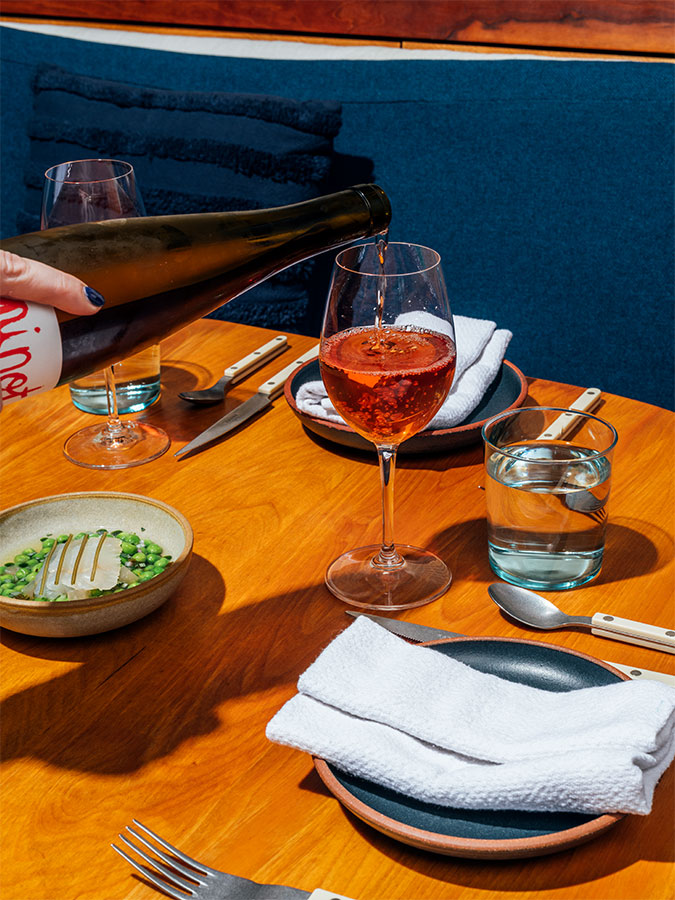
A short skin maceration of red grapes is often at the heart of top-flight rosés, a category that benefited from restaurants taking over outdoor spaces during the pandemic. “I think a big reason rosé is so popular is that the city gave us outdoor dining,” says Jeff Nace, wine director at Neptune Oyster in Boston, MA. “It literally doubles our capacity, so with that situation, you’re doing much higher volume from May first until November first—which is rosé season. And we’re seeing more and more people ordering it year-round; ten years ago, that was kind of unheard of.”

Patrick J. Comiskey covers US wines for Wine & Spirits magazine, focusing on the Pacific Northwest, California’s Central Coast and New York’s Finger Lakes.
This story appears in the print issue of Spring 2023.
Like what you read? Subscribe today.