Five minutes into my conversation with Tegan Passalacqua, grower-winemaker at Turley Cellars, he’s talking with authority about a past he didn’t inhabit, from decades before he was born. “This is where Charlie Myers got his zinfandel in 1965,” he tells me, “the wine that Darrell brought to Trinchero and saved the region.”
We’re at Deaver Ranch in the heart of Amador County in late March, days before budbreak will commence for zinfandel across the Foothills. Deaver Ranch is one of several ancient vineyards coming out of dormancy along Shenandoah Road, where stout, head-trained vines dot the hills like cloves on a Virginia ham.
By Darrell, Passalacqua means Darrell Corti, the grocer, epicure, polymath and proprietor of Corti Brothers in Sacramento. In five days’ time, Passalacqua will be the youngest guest at Darrell Corti’s 160th birthday party in Los Angeles (celebrating a shared birthdate with fellow octogenarian Steve Wallace, the legendary founder of Wally’s Wine Shop in Westwood). But for the moment, Passalacqua is standing in the midst of some of the oldest vines in the state.
The wines from Deaver Ranch have touched more people in more vintages than almost any other wine in California, transcending generations of winemakers and wine-drinkers. As a region, Amador has been around long enough to be discovered, rediscovered, exposed and exploited, its fruit celebrated and manipulated, made into something it’s not, and often underappreciated for what it is. In addition, the vines here are ungrafted and unirrigated, making them vulnerable to the one-two punch of phylloxera and drought.
They also happen to produce clarets of unparalleled structure and character. “These might be the most serious zinfandels in California,” says Passalacqua, who’s been at Turley since 2003. “They’re lighter, have more structure, and they hold their acid. They have more in common with Barolo, or Valtellina.”
Amador is one of eight counties in the western foothills of the Sierra Nevada that double as wine regions, those regions arranged like thick fingers fanning westward toward the San Francisco Bay and outlined by the Foothills’ many watersheds. Amador’s borders are the Cosumnes River and the North Fork of the Mokelumne River, while its western edge is formed by what’s known as the Ridge, a not-quite overlook from which the plains of Lodi and the Central Valley can be glimpsed through the trees, bottoming out the horizon. On clear days, Mt. Diablo is spectral in the distance.
According to Passalacqua, Amador zinfandel’s inherent structure begins with the Foothills’ growing season. The vines are always slow to rouse. Budbreak is quite late relative to the rest of the state: frigid temperatures can linger with the Sierra snowmelt, leaving cold soils and cold roots. The growing season is typically short and intense, the days hotter and drier than in coastal vineyards, with more radial heat. At elevations of 1,500 to 3,000 feet, the region is largely devoid of fog, but there is a dramatic diurnal shift most evenings, slowing ripeness and preserving acidity. By the time the zinfandel fruit reaches harvest numbers, its payloads of acid and tannin are higher and less resolved than coastal fruit. The result is firmer, coarser tannins, more brusque in youth; “That’s why they’re so ageworthy,” says Passalacqua.
Passalacqua makes a half-dozen zins for Turley from Amador: single-vineyard wines from Deaver Ranch and Rinaldi, and old-vine blends named for historical figures like Judge Bell and “Buck” Cobb. These are hardly shy wines (nor are they as big as Turley’s reputation suggests), but their broad shoulders and ample fruit nestle into Amador’s tannic structures with relative ease. They’re not as rich or extracted as Turley’s coastal bottlings, but no less powerful.
The best Amador zin producers lean into the structure. Passalacqua is one; Bill Easton is another. Easton draws from old-vine sources for his eponymous zinfandel label, which complements his Rhône-inspired line, Terre Rouge. But zinfandel is what his parents drank, and what he drank when he was young; “My parents made weekend trips to the Foothills from Sacramento to buy half-gallon jugs from the old Italian mom-and-pop producers,” he says. When Easton ran his North Berkeley retail shop, Solano Cellars, in the1980s, he sold jugs of Amador red to the value-conscious and the thirsty, and he continued to sell them even after he started his own winery.
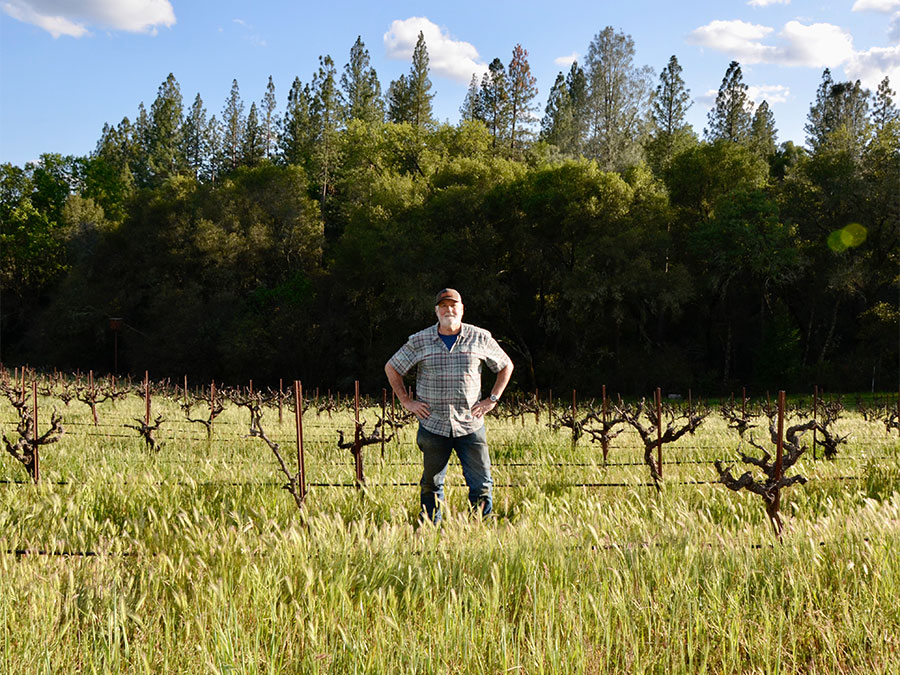
“These were wines of character and wines of the region,” he says. “They expressed our terroir, the black-cherry flavors with that Amador granitic minerality, and a little cedary tobacco component to it. They were made in old open-top redwood fermenters, aged in 20,000-gallon redwood tanks. Very old-school California.” In many ways the zinfandels of Amador County are at their best when they’re still expressing some version of that tradition. This isn’t fruit that likes to be pushed. “They were rustic in their way,” says Easton; “it’s just what Amador brings.”
Easton’s wines, drawn from sites like Rinaldi, D’Agostini and Esola, all over a century old, reflect this kind of structural integrity, defiantly red-fruited and spicy, structured like clarets, the tannins girded with minerals. Easton thinks the ferrous tannins are a function of soils, mostly from the Sierra series, sandy clay-loam, granitic in origin, and moderately dense. Despite their significant water-holding capacity, high yields are all but impossible. “These are poor mountain soils, with a lot of iron and magnesium,” says Easton. “Everything comes in under three tons, even the zinfandel,” adding, “You can’t cheat; if you set a bigger crop, the fruit will never get ripe.”
Head east of the Shenandoah Valley, and the elevations rise; the soils are less granitic and more volcanic, with bands of quartz and shale. That’s where you find Shake Ridge Ranch, a few miles from Sutter Creek, the heart of Gold Country, where Ann Kraemer has planted 46 acres on a dramatically hilly property, with vines emerging between stands of pine, oak and madrone. As we toured the property in her Kubota RTV, mostly in low gear, the winds picked up from the east. “As soon as the Central Valley cools,” Kraemer says, “air from the Sierra rushes in and the vineyard cools down fast.”
Kraemer’s planting is one of the most meticulous in the region, oriented just off-axis from direct summer sunlight, pushing the orientation northwest to southeast. This orientation falls upon the unruly jumble of slopes and swales, resulting in minute variations of ripeness, exposure and shading for the nine-odd acres of zinfandel she has planted at Shake Ridge. Her zinfandel is planted in some of the coolest parts of the property, extending flavor development and leaning into the region’s rustic tannins. “Tegan’s right, it’s all about tannins,” she says. “They’re big, but they’re wound tight.”
Half of Kraemer’s zin vines are head-trained, with the others on trellis, but she modifies the spur position off the cordon to push the foliage away from the centerline of the trellis. Her goal is to improve shading and mimic some of the dappled sun she gets on a head-trained vine.
Her zinfandel blocks are harvested over a three-or four-week span, which is partly due to the variation of the blocks and partly due to her clientele, who have a variation all their own. There’s the crunchy/natty crowdlike Divergent Wine’s Aaron Bryan and Amy Krahe, who pick at 13 percent potential alcohol for a fresh, herbal red. And there are more traditional stylists like T-Vine, whose zinfandel blend, Hill of Thunder, is plush and ripe, getting some depth and cushion from Shake Ridge Ranch petite.
For her own brand, Yorba, Kraemer hews to the middle ground. Ken Bernards of Ancien, in Napa, makes the Yorba wines, and they possess robust tannins that can take years to loosen. But they’re also some of the longest-lived I’ve tasted, as evidenced by a vertical conducted on the property one chilly spring morning, with bottles going back to the mid-2000s, still youthful and firm.
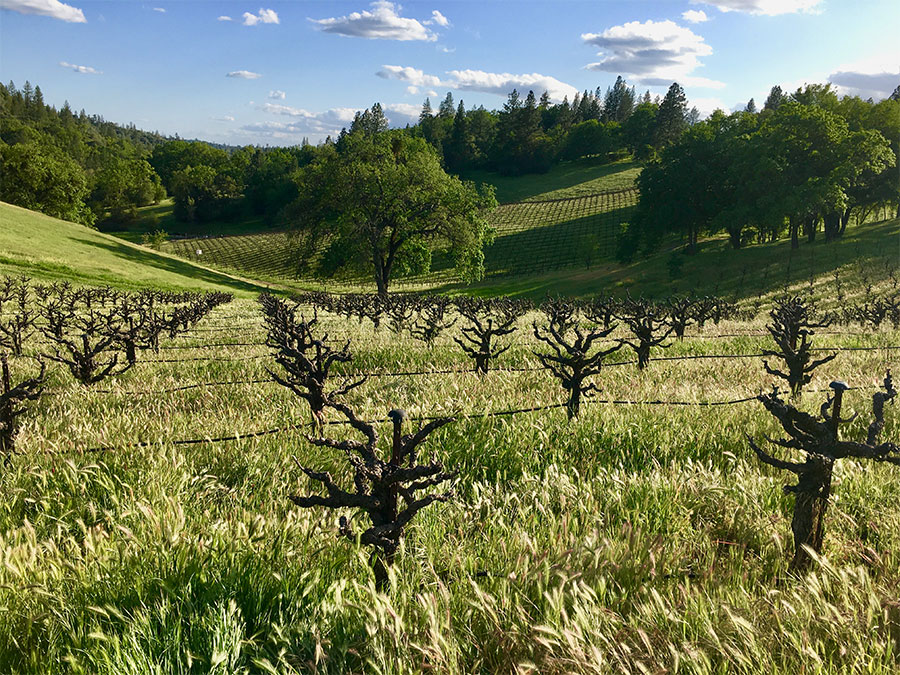
During his real estate career in Hawaii, Andy Friedlander had fallen in love with the zins of Napa Valley and Dry Creek Valley. Once he bought a second home in Napa Valley, though, he quickly tired of the “Disneyland” vibe of Napa and Sonoma. It was Darrell Corti who recommended he look at land in the Sierra Foothills, he says, “where what slows you down on the road are tractors, not limos.”
Friedlander found property across from Easton, and in 2010 built a modern winery in concrete, wood and steel that wouldn’t look out of place in Oakville. He also hired Philippe Melka as his consulting winemaker, so he hasn’t abandoned Napa Valley completely. The Andis winery is surrounded by plantings of traditional varieties, as well as new blocks of arinto, tempranillo, palomino, and schioppettino (the latter planted on the advice of Corti). At Andis, Friedlander’s team also works with three old vineyards: his own Friedlander Block—zinfandel planted in the 1970s—as well as Di Stefano and Grandpere, once thought to be the oldest zinfandel in the region.
Though he’s a Foothills newcomer, Friedlander and his team were game when Darrell Corti’s approached them about an Amador history project: Corti asked them to make a wine to commemorate the life and work of Charles Myers. As he’d done with other special bottlings in the past, he’d go on to sell this wine as a Corti Brothers exclusive.
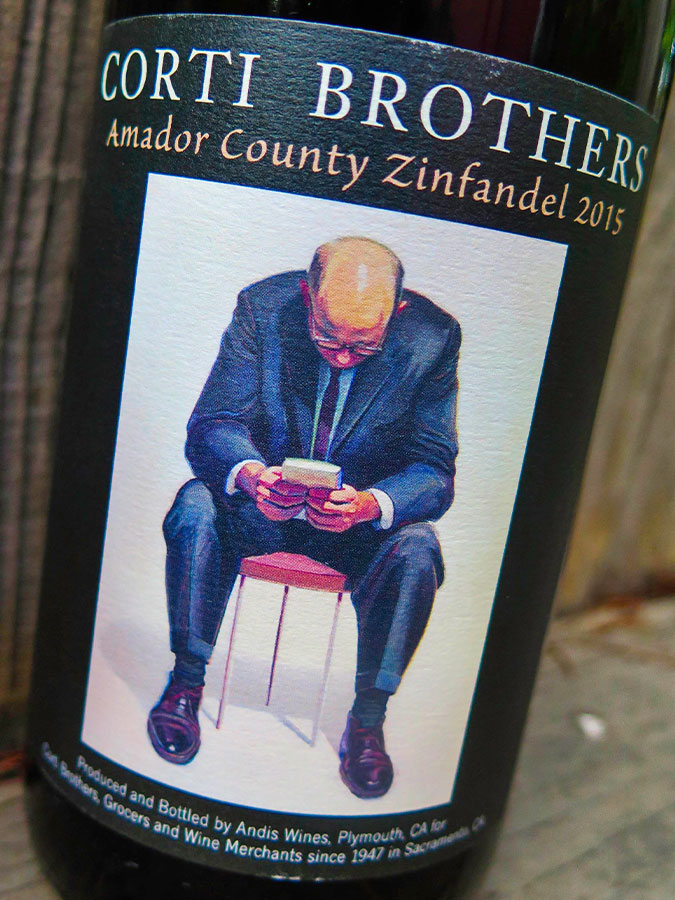
Charles Myers was a professor of English at Sacramento City College in the early sixties, a serious, studious instructor who befriended a young artist also teaching at the school, Wayne Thiebaud. In 1963 Thiebaud painted a full-length portrait of Myers, called Man Reading, which had his friend in a pensive pose, examining a book, his head bowed, his bald pate capturing the gleam of the studio lights. (In 2011, Sotheby’s sold the painting for nearly $2.7 million.)
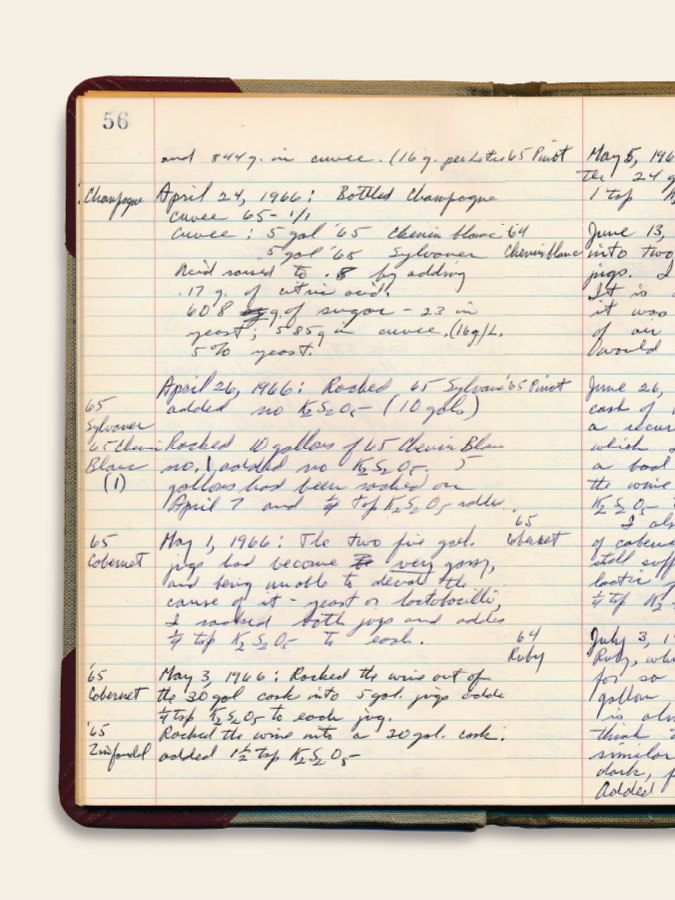
This might have been Myers’s sole brush with fame, were it not for the fact that he was also a talented home winemaker. In 1965 Myers purchased a half-ton of zinfandel from Deaver Ranch, then home to fifty-year-old, dry-farmed, own-rooted vines. He took detailed notes in his winemaking ledger, describing the process in a tiny script and in minute detail.
One year later he gave a bottle to his friend Darrell Corti, who still remembers that wine vividly. “It was very different from what one saw as zinfandel in those days,” he says. “The color of zinfandel had become very pale, compared to zins from the thirties by the likes of Simi, because of their liberal use of carignane. This one, though, this was darker in color, and had a very interesting flavor.” According to Corti, few zinfandels from Napa could match its color and intensity.
Corti was so impressed with the wine that he arranged for Myers to meet Bob Trinchero, founder and proprietor of Sutter Home in the Napa Valley. Within months, Trinchero was purchasing grapes from Amador County. The investment and attention likely saved the region’s old vineyards from oblivion, and led to new plantings which are the foundation of old-vine bottlings today.
Myers died in 2014; at an estate sale held by his daughter, Corti and his aide-de-camp Rick Mindermann unearthed Myers’s winemaking notebook and came up with the idea to make a commemorative bottling, a recreation of the 1965 zinfandel. Corti enlisted the Andis team to make the wine, insisting they adhere to Myers’s original recipe.
The contemporary climate obliged the team to harvest on October 3, a full month earlier than Myers did. Both used a similar Champagne yeast strain that was popular at the time; both pressed off their finished fermentations nearly dry into small neutral wood casks and neutral vessels (in lieu of Myers’s glass demijohns, Andis used flex tanks). Myers bottled his wine after just a short maturation in cask, mainly to get the task out of the way before the start of his fall teaching term. Andis bottled the 2015 almost precisely one year after the harvest date. For the label, Corti received permission from lifelong Sacramento resident Thiebaud to reproduce “Man Reading.”
Tasted in 2022 from magnum, this wine is a full-circle moment, a throwback, with an alcohol of 13 percent. While no one would call it a powerful wine, it is utterly delicious: seamless, briary and tinged with subtle herbal notes of olive and thyme. The short fermentation period and the relatively short maturation time have, to Corti, rendered this wine pretty and approachable. “That’s the character that first brought Amador to the wine world’s attention,” he says. For some, it is a character worth returning to.

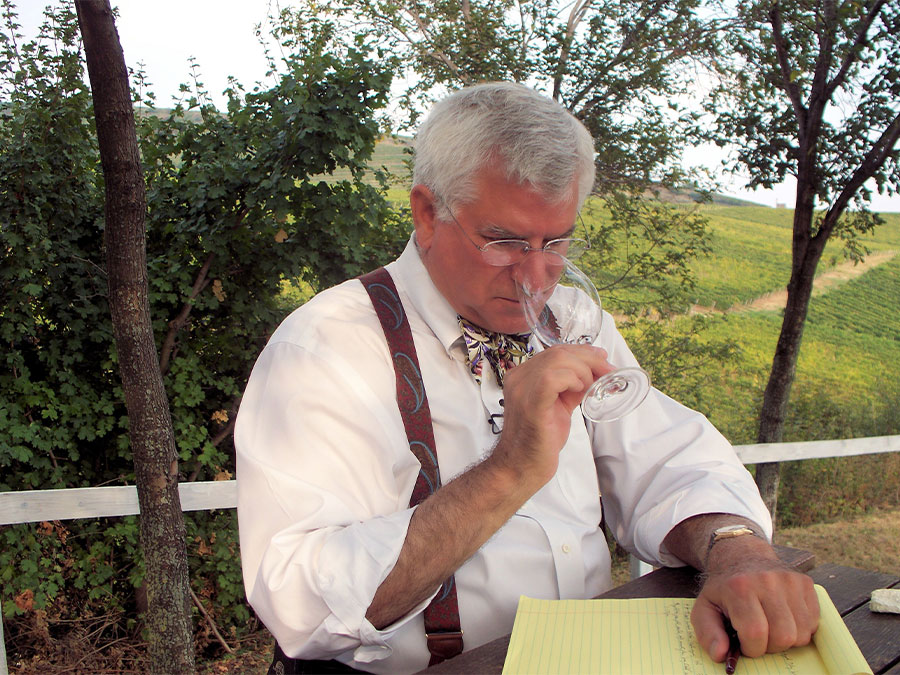
Patrick J. Comiskey covers US wines for Wine & Spirits magazine, focusing on the Pacific Northwest, California’s Central Coast and New York’s Finger Lakes.
This story appears in the print issue of Summer 2022.
Like what you read? Subscribe today.