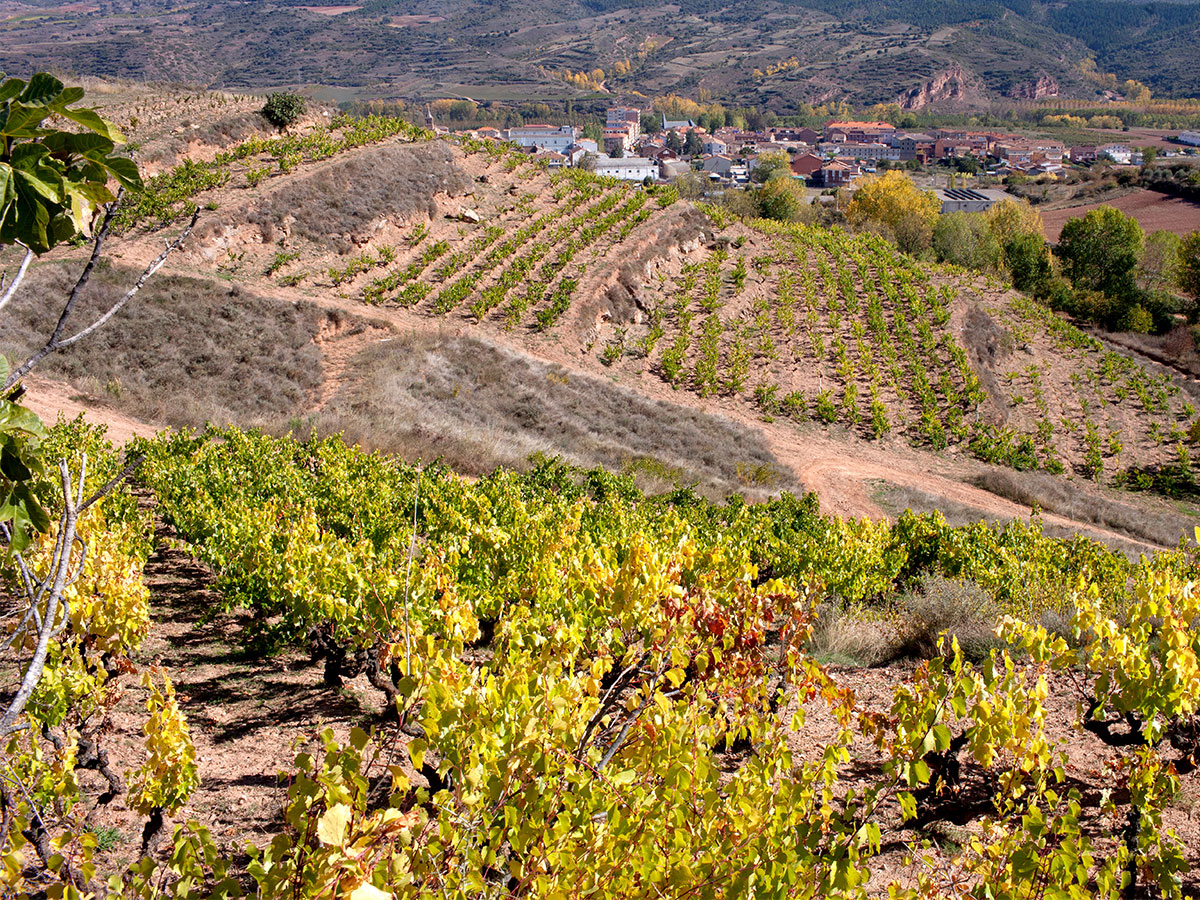
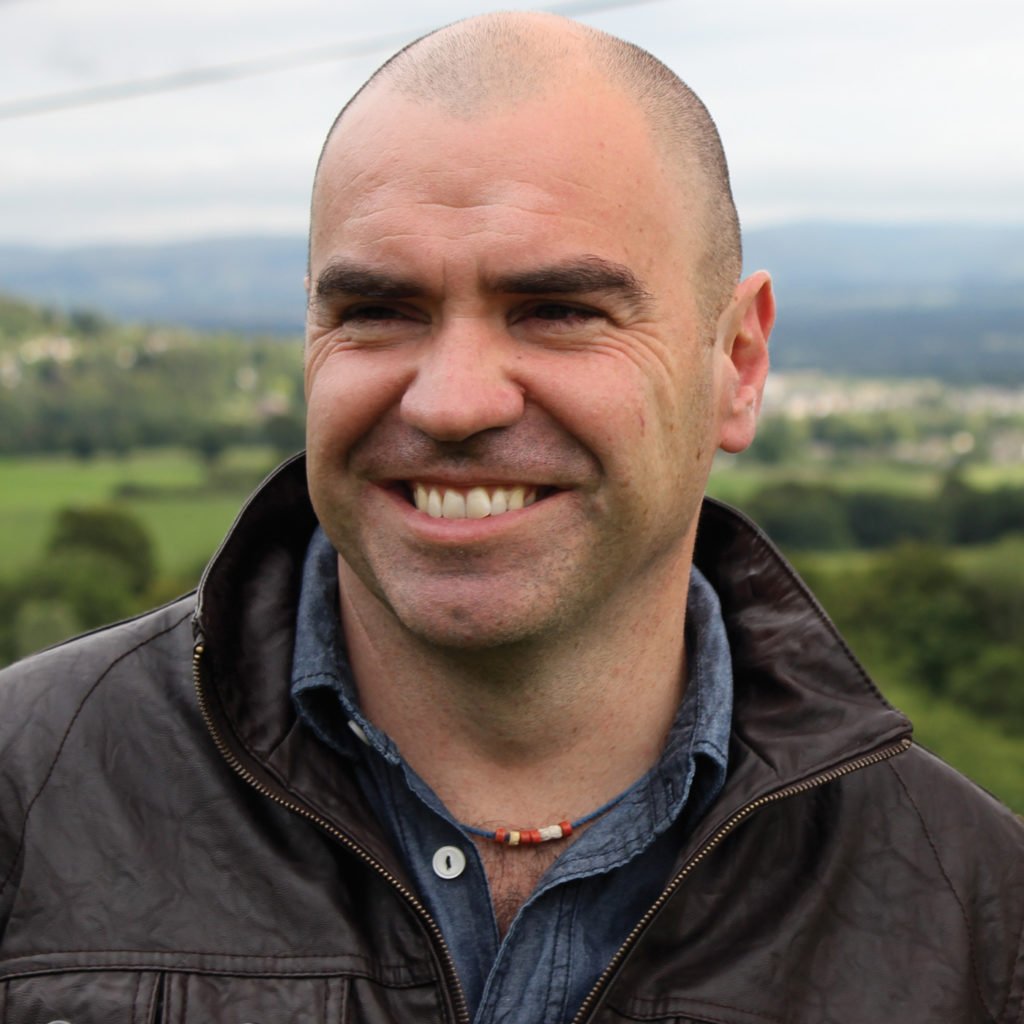
Juan Carlos Sancha tends centenary garnacha vines in the Najerilla valley, including this parcel which he presents in his Viñedo Singular Cerro La Isa Garnacha.
I don’t know how to drive with a manual shift. This doesn’t hurt my ego at all, but it becomes a problem in Spain. There aren’t many cars with automatic transmissions to rent, and even fewer outside of Madrid or Barcelona. Often, when you speak like a local, the rental agent will check to make sure you do not want a manual.
In Zaragoza, I had three choices. It felt like when you don’t know the wines by the glass, you pick the one priced in the middle… but then they upgraded my reservation, and I ended up with a sports car from Mercedes-Benz. I could not care less about cars, but I have to say that it felt great driving from Zaragoza to Logroño. Maybe because there were no car seats for the kids in the back, or because I am getting close to forty, and it made me feel cool…until I didn’t know how to change the radio station and had to listen to Radio Maria, with its Catholic songs and sermons. Even in the most remote corner of Spain, Radio Maria will be there.
I pulled off the highway and found another station, then turned onto a local road behind a tractor hauling grapes, one of the hundreds of tractors on the roads in Rioja during harvest—the driver looking at a very-pretentious me in my fancy car, with plenty of time to hold that stare.
Naturally my adopted New Yorker frustration came out right away, then my Catholic education took me to resignation, and, after a few miles, I became thankful to this tractor driver for pushing me into the slow lane, slower than the speeding pace of a New York City sidewalk. He gave me the chance to realize how beautiful Rioja is, particularly at harvest, with the leaves changing color on the vines.
Eventually, I pulled off into an old Rioja vineyard. The top terraces were yellow, the head-pruned viura planted in the poor soils already harvested and done for the season. The center of the hill was purple, planted to tempranillo vines still laden with ripe berries. Garnacha filled in the bottom, its leaves still green, its grapes still full of acidity, as if holding the door for the other grapes. You go first, please.
Among Rioja’s winegrowers, those most loyal to garnacha value its resilience and rustic character. And yet, garnacha remains underrated, like a local bar that remains a favorite because it never gets too popular. Unfortunately for those who love garnacha, that means that a lot of old vineyards continue to be pulled out. But today, even as less garnacha remains planted in Rioja, there are more good garnachas than ever before.
Sandra Bravo believes garnacha does not lie.
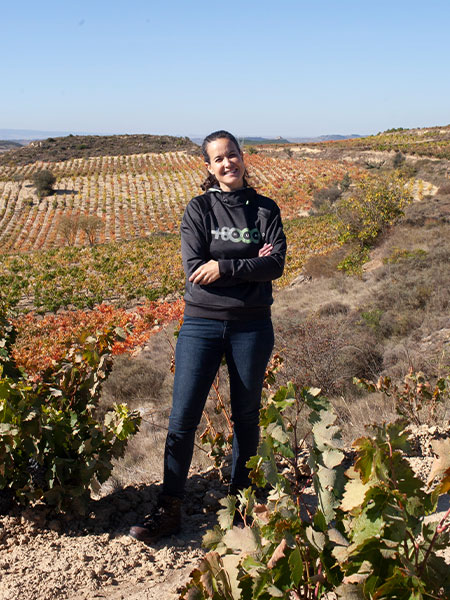
The winegrower behind Bodega Sierra de Toloño, Bravo was born in Logroño and returned home to Rioja after working as the vineyard manager for Scala Dei in Priorat (and traveling to work in California, Australia, Italy…). She believes a winemaker’s personality comes out in their garnachas or, said another way, garnacha is a great way to express creativity in Rioja.
Bravo’s cellars are directly across from Izadi, like an independent bookstore across the street from a Barnes & Noble. She loves her rented winery with three floors, two of them underground. While I was visiting , her landlady arrived and suggested she sleep in the guestroom at her family’s house, a subtle motherly criticism that Bravo was working too late during harvest. She also invited her to eat with them, one of the most hospitable Spanish customs, explained with a shrug: “Donde comen dos, comen tres.”
The town of Villabuena de Alava has adopted Bravo—to a degree. As a woman running a winery, she still has to deal with questions about where her man is, particularly if she is seen carrying heavy equipment or when she is trying to buy a plot of vines. But that has not stopped her from buying several parcels that she dreamed about for years. Her first varietal garnacha came from a vineyard planted in 1944; it had been owned by an old man, and she had asked him about the parcel so many times that he eventually sold it to her in 2014, having decided she would be the one to best care for the vines.
Bravo is inspired by the “garnacha Atlántica,” as she calls it, based on the 60-mile distance to the Cantabrian Sea. She seeks out vineyards high up in the mountains, where parcels have been abandoned and are likely to be sold to growers who want to transfer the planting rights.
In the 1970s, there was more garnacha than tempranillo planted in Rioja. But by 1983, the tables had turned: there were 37,000 acres of tempranillo and 29,650 acres of garnacha. Now, the spread is far greater: 130,960 acres of tempranillo and 11,100 of garnacha. Today, driving through the mountains in Rioja Alta and Alavesa, there are any number of old terraces cleared of garnacha vines, before growers like Bravo could get there first.
For the old-vine garnacha she does manage to recuperate, Bravo prefers to let the wine rest in amphorae rather than oak barrels. From her perspective, clay vessels are the best way to respect the flavor of garnacha, sustaining “la frescura” (the freshness), basing the wine’s aging potential on acidity rather than on tannins from oak barrels.
Rioja native Sandra Bravo looks for freshness in garnacha grown in Alavesa’s northern mountains, under the influence of the Atlantic.
Fifteen minutes northeast from Villabuena, I stopped at Laguardia, leaving my car at one of the five gates into the walled village. There are so many cellars carved in the rock that locals are certain, if cars were allowed through the gates, the village would collapse. It’s already holding up the weight of three different Spanish cultures, all contributing to what Rioja has become. Founded by the kingdom of Navarra as a defensive fort, Laguardia was taken several times by the Castilians and, since the 15th century, has been part of Basque Country.
David Sampedro grew up nearby, in Elvillar, a ten-minute drive to the northeast. After working as a winemaker throughout Spain, he now focuses 99 percent of his efforts in his hometown. He still makes wines from rufete in Salamanca, the last of his outside projects. Before 2012, he would store his own wines at the bodegas where he was consulting. Then, after he partnered with Melanie Hickman, the couple built their own home and bodega on a parcel of land with views of the Sierra de Toloño to the north.
Most of their vineyards are in Elvillar (or Bilar in Basque). He works this land with the pride of a native who wants to prove something, though he continues to explore further north, in Cripán, for the higher altitudes and cooler temperatures, where he is farming two “phincas.”
He has been managing all their vines under biodynamics since 2008, and says it just makes sense to him. There’s nothing bohemian or hippie in Sampedro to drive that decision; it is all empiric and realistic. Hickman softens his realism: Sampedro can let the cover crop grow, but it is Hickman who makes the flowers flourish. She left Hawaii to move to Rioja Alavesa, bringing her energy to give this yin-yang adventure the necessary balance and harmony.
In addition to making some of the most deeply flavorful white wines in Rioja, they are planting only garnacha (and some graciano) at high altitudes. They are propogating the vines from cuttings sent by Sara Pérez in Priorat as well as selections from their own vineyards, planning to use the fruit from those cooler parcels to blend with their higher-alcohol lots, to mitigate the effects of climate change.
Phinca el Vedao is a garnacha that summarizes the concept behind Bhilar’s “vinos de finca.” The wine speaks of the freshness of the vineyard, but it does not follow the latest trend of light-colored, ethereal garnachas from Gredos, in the hills above Madrid. It has muscle, (like Sampedro himself, a former rugby player). The wine’s dark fruit and structure give Sampedro the confidence to age it for 30 months in used French 500-liter barrels, knowing that oak is not necessarily what wine critics are praising these days.
Just east of Elvillar, in Lanciego, Roberto Oliván found himself in the centuries-old Rioja battle between winegrowers and wineries. He may seem like a free spirit, but he could not afford to grow grapes at the price wineries were willing to pay for them. So, Oliván decided to make his own wines. He farms 30 parcels, a total of 25 acres in Lanciego and Viñaspre, using only his own grapes for his wines.
Like other independent wine growers, one of his part-time jobs is hunting for small parcels that cannot be farmed by tractor, so the big wineries with substantial financial backing have no interest in buying them.
I don’t think it’s wrong to say that Oliván is kind of obsessive when it comes to caring for his vines. During the pandemic, since there were no visitors coming. and he was not traveling, Oliván was happy spending all of his workday in the vineyards, where his vines seem to have had a pedicure and manicure every week, looking as radiant and healthy as they can be. “This is the only way I can leave a great legacy,” he says, “for my kids.”
For all his hard work in the vineyard, in his cellar he has found himself rejecting any of the tools or techniques he believes would cover the purity and mask the origin of his wines from his village. He produces 1,200 bottles of El Abundillano, from a 2.5-acre parcel his mother owns in Viñaspre. This is Atlantic-influenced garnacha, with a beautiful floral and herbal scent that might divert you; then, when you do go on to taste the wine, you’ll find it’s light, but it walks firmly, making every step count with red fruit at the precise point of ripeness. It defines Oliván’s goal of purity in his garnacha.
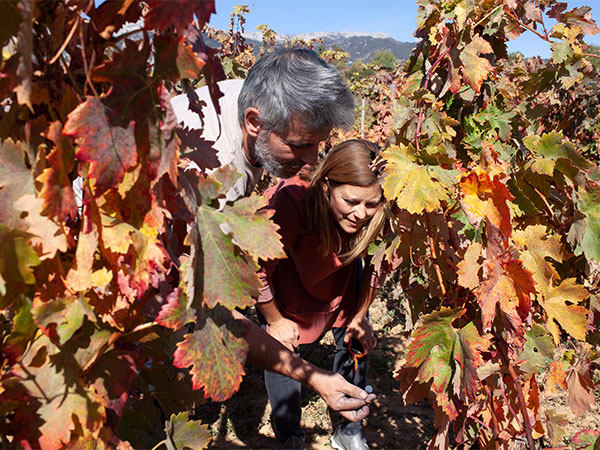
Melanie Hickman left Hawaii to join David Sampedro in his hometown of Elvillar, to farm garnacha in Rioja Alavesa, where they produce a range of phinca wines.
When I arrived in Sajazarra, crossing the region from the eastern reaches of Alavesa to western Rioja Alta, I told Oscar Alegre and Eva Valgañón that I was coming from Lanciego. They looked at me like I was crazy.
For me, it was no farther than my commute to work, but distances have a different meaning here. I would happily commute every day on that same road, surrounded by vineyards and campanarios (bell towers) but only if I could do it at 15 miles an hour.
Alegre himself is from eastern Rioja, what was then called Rioja Baja, now Rioja Oriental; Valgañón is from Rioja Alta. They met while studying in Italy and have since formed the classic Rioja blend, through marriage. They chose to settle in Sajazarra for its climate, the most Continental—or Atlantic—weather conditions in Rioja. Climate change has made it easier to ripen grapes here, though they still ripen late in the season, with low pH and fresh acidity, producing elegant wines with the potential to age. Still, they continue to blend their own tempranillo with garnacha grapes they purchase in Rioja Oriental.
Eva’s family owns old-vine garnacha parcels in Fontaleze, right at the border between Rioja and Castilla y León. For their 100-percent garnacha bottling, also a pan-Rioja wine, they have been recuperating some of those parcels and now blend that fruit with garnacha from Cárdenas in the Najerilla Valley, in the southeastern corner of Rioja Alta. This wine has the Mediterranean spirit of garnacha from Najerilla with all the freshness of the Rioja Alta hills. Very aromatic, with a strong presence of dried flowers and ripe red berries, this wine gets its fullness from the deep soils of Cárdenas and its vibrancy from the rocky calcareous soils of Sajazarra.
Alegre and Valgañón also make a small amount of a clarete-style wine, Carra Sto Domingo, a blend of 60 percent garnacha with viura, aged in large barrels. A single vineyard field blend, it’s a wine that stayed with me—I was still remembering its taste when I landed back at JFK.
Clarete was a historic style of wine, before oak aging became the tradition; it was held in concrete until the next harvest, when the growers needed the space. Its lightness and low alcohol made clarete a wine to drink all day long. The depth, structure and freshness of Carra Sto Domingo is absolutely delicious, a credit to Valgañón’s Sajazarra ancestors and the synergies of their field blend.
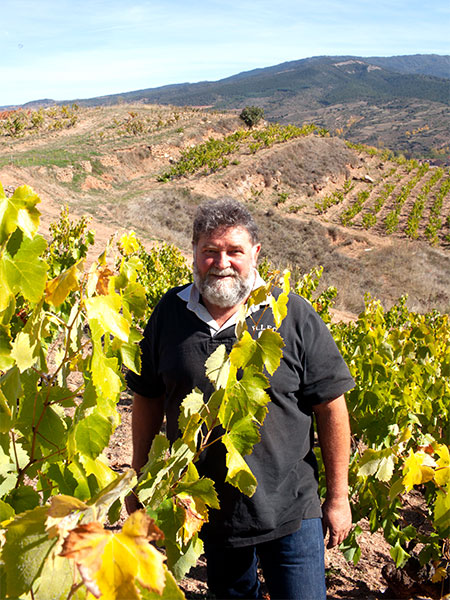
In Rioja Alta’s southeastern mountains, toward the headwaters of the Rio Najerilla, Juan Carlos Sancha waits to harvest some of the region’s highest parcels, where his garnacha ripens late into October.
That night, I stayed in Haro, a Friday night with an end-of-summer feeling that reminded me of pre-pandemic days. The streets were packed with people of every age, and young drinkers buying bottles of unbranded white wine for a couple of euros. There was no White Claw in sight. While Haro and Logroño get a good amount of wine tourism, in a friendly competition over which one is the capital of the Non-Basque Rioja, visitors rarely travel to the south of Rioja Alta—my next stop.
David Sampedro had told me that I had to visit Juan Carlos Sancha if I wanted to get a real idea of the history and current state of garnacha in Rioja. To introduce us, Sampedro created a Whatsapp Chat, calling it “Searching for Garnacha,” and sent a message of introduction. The next message was, “David has left the chat.”
In the Najerilla Valley, temperatures are the lowest in the entire Rioja appellation, and the elevations rise as high as they do in the northeastern hills of Rioja Alta and Alavesa. The Najerilla river descends from the Picos de Urbión, creating the iron-rich, red-clay soils of settlements like Baños de Tobia, a small town producing jamón and chorizo, where wine has never been the main activity. More parcels of old garnacha vines have survived in the area than in other parts of Rioja; local growers were not relying on their vineyards to make a living, so they had little incentive to switch over to the more reliably productive tempranillo.
Today, many of those old-vine parcels are sustained by Juan Carlos Sancha, a native son of Baños de Tobia and now the oracle of Rioja Alta garnacha. Actually, he is best known as a professor at the University of Rioja, where several of the garnacha growers I previously visited had studied.
He is also devoted to recovering indigenous grapes, some nearly extinct, providing fruit for an unusual range of wines. He makes a superb tempranillo blanco, a maturana tinta and maturana blanca, and a monastel, a rare variety I had never tasted before.
Aside from those, he has nearly a dozen different bottlings of garnacha. And not a single tempranillo. A brave move if you consider that, according to surveys in the UK, Germany and the US, at least half of the people who know Rioja know tempranillo. Only about five percent of them would relate garnacha to Rioja.
Sancha’s wines defy what he calls “all the fake news” about garnacha. Peña el Gato, his flagship red, is juicy, spicy and floral; its color is vivid and its tannins soft, with plenty of refreshing acidity (it does not go through malolactic fermentation, as there is not a lot of malic acid in the grapes). He makes the same wine, (from the same vineyard, with the same length of aging) but in tinajas (clay pots), a garnacha that brought to mind the purity other growers had mentioned as their goal.
“I am sure we make better wines these days than in the past,” Sancha told me as I was leaving, “but I’m not sure that we have better grapes.” I turned off the radio as I drove back to Zaragoza, listening to the rain, watching as it brought out a beautiful color from the red soils of Rioja Oriental. Here, there were no grapes left to pick, while high up in the Najarilla Valley, Sancha won’t likely finish harvest until four weeks from now, at the end of October.
In fact, Sancha may be farming better grapes than in the past, and the same could be said for the other winegrowers I visited. Waiting for garnacha to ripen, they are in no rush to harvest because, for them, farming is a life project, not a business. And because they are not afraid that garnacha will tell you, with the most sensual voice, the truth.
This story appears in the print issue of December 2021. Like what you read? Subscribe today.
Stephanie joined Wine & Spirits Magazine as Tasting Director in 2013 and became Italian Wine Editor in 2016. She spends a significant amount of time each year visiting Italy’s wine regions, tasting with producers and researching articles about their practices. Stephanie holds the WSET Diploma in Wine & Spirits and has worked in the wine retail and restaurant sectors, including five years as Wine Director at City Winery in NYC’s SoHo district. She previously worked in textbook publishing as an editor and marketing manager in Minneapolis, Chicago, Austin and Tokyo.
Thomas Whalen.
Sales Manager
Tom worked in fine wine sales at Zachy’s in Westchester and Crush in NYC before joining the W&S team handling advertising sales. A graduate of Skidmore College, Tom got his start in the industry through hospitality, including a stint as the GM and partner in Post Office Bar. He has also done consulting work for private clients on their wine cellars.
Tom brings a depth of knowledge to his role and, when he’s not networking with marketers, he’s busy raising his one-year-old son, listening to classic rock, or dipping back into Jon Bonné’s California Wine.
Alissa Bica
Tastings Coordinator
Based in Los Angeles, California, Alissa Bica is the Senior Spirits Editor and Critic at Wine & Spirits. She is also an Advanced Sommelier and, in any rare moments of free time, writes about obscure grape varieties in the blog Off the Beaten Wine Path.
David Paradela
Associate Editor
David joined Wine & Spirits in 2021 after immersing himself in the world of wine at the start of the COVID-19 pandemic. Originally from Boston, he graduated from Boston University with a degree in English and completed a master’s degree in Publishing and Writing from Emerson College in 2021. Prior to working at the magazine, he served as an editor and staff writer for the music blog Sound of Boston and worked in scientific publishing. Aside from wine, he loves basketball, arguing about Taylor Swift’s best album, and everything Greta Gerwig touches.
Corey Warren
Tastings Editor
Corey Warren moved to New York in 2015—fifteen years too late to join The Strokes—after earning a degree at Cornell in Comparative Literature. He started polishing glasses at Betony and threw himself into the restaurant world. Later, while a captain at Aquavit, he began working part time in the Wine & Spirits tasting department. Now, in addition to running tastings, he serves as critic for the wines of the Loire, Southern France, Argentina and South Africa. Corey likes almost anything bubbly, from Miller High Life, the Champagne of beers, to Champagne, the Champagne of Champagne, but he’ll drink anything once, and loves finding unique wines.
Tara Q. Thomas
Editor at Large
Since Tara Q. Thomas joined Wine & Spirits in 1997, she’s traveled the wine world from Argentina to Australia. A graduate of the Culinary Institute of America in Hyde Park, New York, with more than 20 years of experience in the food and wine world, Tara puts her culinary knowledge to use as W&S’s resident food critic, and is the critic for the wines of Austria, Germany, Eastern Europe, Argentina, and the Mediterranean. She’s particularly enthusiastic about the wines of Greece, where she once lived and cooked. Outside of W&S, Tara has authored two books, The Complete Idiot’s Guide to Wine Basics and The Pocket Idiot’s Guide to Wine; contributed to the Oxford Companion to Cheese as well as Oxford’s forthcoming volume on spirits; and writes a wine column for Culture: The Word on Cheese.
Patrick J. Comiskey
Senior Correspondent
A former sommelier, Patrick J. Comiskey serves as the W&S critic for all domestic wines outside of California—including New York, Oregon and Washington—and contributes articles on the wines and viticulture of these areas. His wine travels include regular visits to US wine regions, as well as trips to France, Italy, Germany and Australia. Comiskey’s writing credentials include contributions to the San Francisco Chronicle’s wine section, the Los Angeles Times, Bon Appétit and the Robb Report, and also teaches classes and moderates panels on viticulture, wine tasting and various wine regions. His recent book, American Rhône: How Maverick Winemakers Changed the Way Americans Drink (UC Press 2017), was shortlisted for the 2016 André Simon Food & Drink Book Award and 2017 Louis Roederer Domaine Faiveley Wine Book of the Year.
Annette Farrell
Production Manager
Annette's entire career has revolved around magazine and print production, developing systems, and providing production support for dozens of magazines at a number of large publishing companies, including McGraw Hill, Condé Nast, and Hearst. Annette has joined the Wine & Spirits team to manage our production systems and develop and optimize our print production process.
Susannah Smith
Editorial Coordinator
As a retail buyer, Susannah traveled abroad extensively, especially in Italy and Greece, to learn the stories behind her favorite wines and then connect others with the vines and the humans that make them. She is excited to join W&S, since that is the magazine’s mission. Raised to be curious, she finds, after over 20 years in the world of food and wine, that she loves best how wine touches so many disciplines—history, language, geology, cuisine, biology, horticulture—keeping the quest for knowledge fresh every day.
Joshua Greene
Publisher & Editor
Editor and Publisher of Wine & Spirits since 1986, Joshua Greene began drinking wine with meals during a summer in Galicia, Spain, at the age of 13. In later years, he worked in wine shops in western Massachusetts and served as wine captain at Wheatleigh, a small inn in Lenox. After graduating from Princeton University in 1981, Greene pursued a career in magazines, focusing on the management of special-interest publications. His work with Wine & Spirits began on a consulting basis, eventually leading to his purchase of the magazine in 1989.
Greene has traveled extensively in the wine regions of Bordeaux, Burgundy, Champagne, Portugal, Italy, Spain, Australia, New Zealand, Chile, and all the major wine regions of the United States. In addition to his duties as editor and publisher, Greene serves as the critic for Napa Valley, Bordeaux, Burgundy, Champagne, Portugal, Rioja, Australia, New Zealand and South Africa. He also writes feature stories and commentary for each issue of the magazine.
Nick Mrozowski
Art Director
As the former creative director of WWD magazine and Adweek magazine in New York Nick has extensive experience in the areas of advertising, marketing and branding.
Roy Schneider Jr.
Director of Finance
Roy joined Wine & Spirits in 2003 to oversee the daily and long-term finances of the magazine. He handles cash flow works alongside the publisher to develop and fine tune strategic plans; Roy also manages basic business operations of the company—from IT to human resources. If there’s a problem, he’ll solve it.
Having begun his career on Wall Street, Roy holds an MBA from NYU Stern School of Business and has worked for a number of corporate and boutique firms from New York to Japan. While he clearly enjoys wines—having, over the years, sampled many thousands—he remains true to his Caribbean roots and maintains a primary love for rum.
Chloe Jenkins
Account Manager
Having spent nearly a decade in the marketing world, Chloe followed her enthusiasm for wine to work at a wine marketing company, before joining the team at Wine & Spirits. She loves using creative strategy to help brands tell their stories and connect with their audiences. Chloe holds a Level 3 (Advanced) Certification from the WSET, as well as specializations in French and Italian wine.
Patricio Tapia
Senior Correspondent
After graduating with a degree in journalism from the Universidad de Chile in Santiago, Patricio Tapia attended Bordeaux University in France, where he studied for a diploma in wine tasting and winemaking. Since then, he has visited wine regions around the world and authored several books, including his annual Descorchados, a Chilean wine guide; The Wines of Colchagua Valley;TodoVino and Wines for Great Occasions. Tapia is also the South American correspondent for The Oxford Companion to Wine,The World Atlas of Wine and Oz Clarke’s Pocket Wine Book. For the past three years, he’s been a host on the El Gourmet channel in South America. At Wine & Spirits, Tapia is the critic for the wines of Argentina, Chile and Spain, and regularly contributes articles on these regions.
If you would like to continue using our Wine Search, please create an account with us today.