Food photography by Adam Friedlander
Greece has never had a shortage of rosé. “When it’s 35 degrees Celsius and you’re sitting outside at a taverna, it’s difficult to have a red wine,” says Stelios Boutari of Kir-Yianni. “So, you have rosé.”
His experience may be colored by the fact that he’s from Macedonia, where xinomavro rules. It’s the bad boy of Greek wines, tannic and leather-jacketed, a grape with attitude, as its name, “acid-black,” suggests. Drunk young, the red wines can be an intense experience; they need years to turn into the velvety, truffle-scented wines that have been sought after since the 18th century. The pink versions, on the other hand, highlight all the grape’s most charming aspects—the fragrant cherry and rose scents and the signature earthy savor, all bolstered by bright, lively acidity.
Xinomavro rosé is right at home at a Greek meal, with its cacophony of flavors—the mix of small plates scented with garlic, doused in olive oil, charred over vine branches, punched up with feta, olives and showers of fresh oregano. The wines have the structure to stand up to all the many things that come fried, to dip in garlicky tzatziki, like zucchini rounds and little fish; they won’t shy away from a platter of lamb chops piled a foot high. Spicy loukaniko sausage, fiery red-pepper dip, meltingly tender, smoky eggplant—bring it on.
What’s more, while xinomavro’s territory is pretty tightly limited to northern Greece, it’s marvelous at showing minute changes in climate, soil and geography, allowing for a range of expressions particular to place. So, I asked sommeliers around the US for some of their favorite xinomavro rosés, and how they like to use them. Here’s a guide to a few of the best.
Amyndeon
“I love xinomavro because it’s so flexible; you can make great white wines out of it as well as rosé and red; you can even make sparkling,” says Evan Turner, sommelier at Krasi in Boston. In fact, he pours two sparkling xinomavros rosés: the deeply colored, off-dry Akakies from Kir-Yianni and the bone-dry, méthode traditionelle rosé from Karanika. “It’s so good I will set it up against Moët or Veuve,” he says, referring to two popular Champagnes.
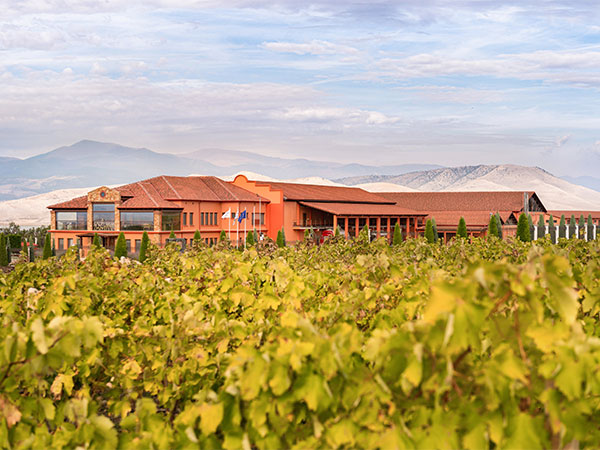
Photo courtesy of Alpha Estate
This is not a new trend like Prosecco rosé: Amyndeon’s sparkling xinomavro rosé has had PDO status since 1972, making it one of the earliest delimited wines in the country. In this cool region—a high plateau near Greece’s northern border—sparkling wine made sense, as xinomavro didn’t always ripen before the autumn rains.
But there’s more to it than temperature: The region also stands out for sandy terroir, which encourages more fragrant, delicate xinomavros than those from heavier soils. So, while it’s no longer as difficult to achieve ripeness today, with the warming climate and better farming techniques, rosé—both still and sparkling—remains an essential part of local winemakers’ portfolios. Kir-Yianni now makes three rosés from Amyndeon fruit, including the new Esprit du Lac; at Alpha Estate, Angelos Iatrides makes one of the favorite rosés poured at Molyvos in Manhattan. “Yesterday I had a party of six,” sommelier Kamal Kouiri told me, “and they all ordered different things, so they didn’t know what to do. I poured them the Alpha Estate and they went through five bottles, first with some spreads and saganaki, then with lamb chops and moussaka.” And that was last year’s vintage, he says: Because of its firm acid structure, Amyndeon rosé is often even better with a year in bottle.
Naoussa
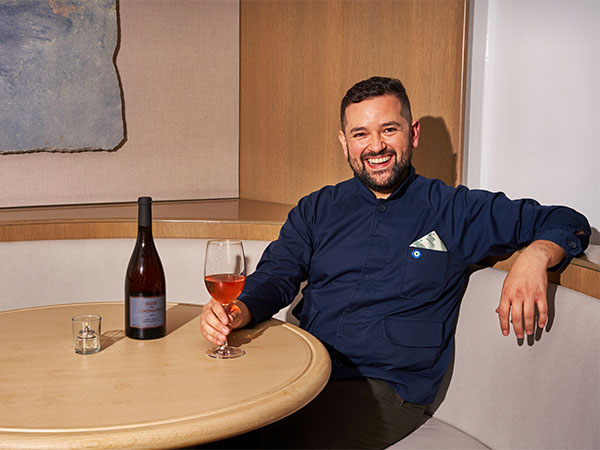
from Thymiopoulos in Naoussa to match the complex spice of
chef John Fraser’s Mediterranean cuisine.
At Iris, chef John Fraser’s Mediterranean restaurant in Midtown Manhattan, sommeliers Amy Racine and Miles Hunter have been pouring Apostolos Thymiopoulos’s Rosé de Xinomavro since reopening this spring.
That rosé comes from Naoussa, an hour to the east of Amyndeon, on the other side of the Vermio Mountains. About 1,000 feet lower in altitude, the region is noticeably warmer, and the soil heavier, ruddy with iron in places. What isn’t different is the vines: After Naoussa was decimated by phylloxera in the late 1880s, the region replanted with stock from Amyndeon, where the sandy soils kept the louse at bay. It turned out to be an interesting experiment in terroir expression, as Naoussa’s xinomavros are noticeably brawnier than those from Amyndeon—so much so that Thymiopoulos gives his rosé some barrel age.
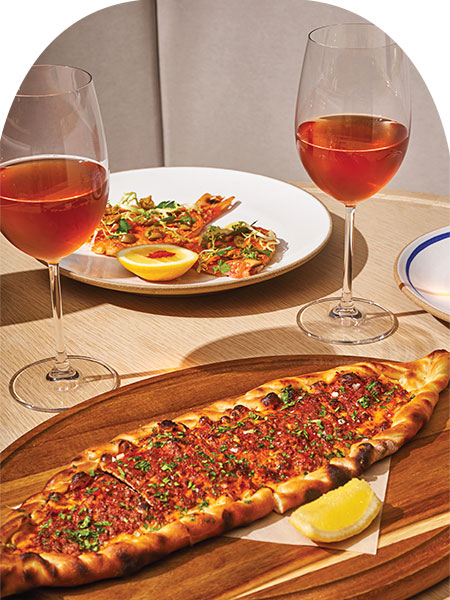
But Hunter doesn’t tend to mention the wood. “Instead, I talk about the texture,” he says. “It’s full-bodied and juicy, and the xinomavro is clearly showcased in its vivid black-cherry and wild-strawberry flavors, and that savory edge.” At Iris, Hunter finds it has the heft to take on the complex spice of many of Fraser’s dishes, which reference both Greece and Turkey. He points to a Turkish flatbread as an example, topped with ground lamb seasoned with cumin, sumac and chile. It’s a particularly apt pairing given the long Ottoman influence on Macedonia’s cuisine.
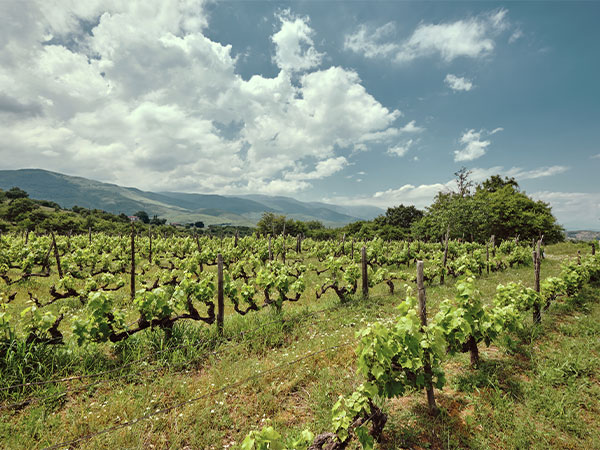
Photo courtesy of Thymiopoulos Vineyards
Siatista
At Nostos in Tysons Corner, just outside of Washington, DC, Angela Pagonis has her own favorite rosé. “I particularly like rosé from xinomavro because of the acidity and tannins, which gives it more dimension,” she says, “but especially from Siatista.”
About an hour south of Amyndeon, Siatista was once a major wine town, hidden in the rugged, forested Voio mountains at 2,800 feet in altitude. Grape sugars didn’t always accumulate quickly in the cool climate, so winemakers in Siatista took to concentrating those sugars by laying the grapes out on covered racks to dry in the wind. They built a trade in vin liasto, a sweet wine that was stable for travel.
To sweeten the blend, they included a bit of moschomavro, a black muscat. The aromatic grape makes its way into the region’s dry wines, too, like the Dio Fili Rosé that Pagonis pours. “Because of that little bit of moschomavro, there’s more aroma. It softens [the xinomavro] up a little; it’s not harsh on the corners,” she says. “It’s also really flexible, because it has weight, dimension and acidity,” she says, adding that it’s one of the few rosés that can handle red-sauced foods, “like seafood youvetsi with shrimp, mussels, calamari and octopus in a light tomato sauce that we serve over orzo, or shrimp saganaki with tomato sauce and feta cheese on top.”
Velvendos
“A few years back, we got to meet Yannis Voyatzis,” says Nicholas Kefaliakos, the beverage director for Taverna Kyclades in Bayside, New York. “It was a Tuesday night, and it was raining, and when he arrived, there were forty people at the bar, all drinking Voyatzi Rosé. He was like, what’s this? Is this for me? But it wasn’t: That’s every night here. People love that rosé.”
Kefaliakos, for his part, remembers the first time he tasted Voyatzi Rosé. “I love mourvèdre, and it immediately made me think of Bandol,” he says, pointing to the vibrant color and earth tones beneath the fruit. “But also, we have something in Greece called loukoumi”—a soft jellied sweet. “What jumped out to me is loukoumi of roses.”
That florality is one of the hallmarks of Velvendos xinomavro. The region is about an hour east of Siatista, but warmer, as it’s lower in altitude, nestled between Lake Polyfitou and the Peiria mountains. The area also has its own clone of xinomavro, less tannic and more aromatic than the Naoussa clone, yet still retaining the grape’s hallmark acidity. “The acidity makes it very easy to pair it,” says Kefaliakos. “We recommend it a lot with langoustinos; or shrimp Santorini with tomato and feta, or grilled octopus… It’s not just very refreshing but also very fulfilling,” he says, searching for a way to describe its warm, generous Velvendos personality.
Epanomi
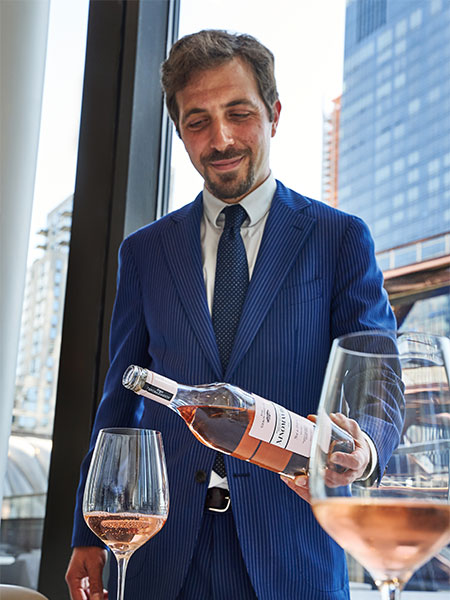
of xinomavro rosé to complement the signature
tuna burger at Milos Hudson Yards.
Dimitrios Manousakis handles the wine at Milos Hudson Yards, on Manhattan’s far west side. When I ask him what he’s been pouring this spring, he doesn’t hesitate. “Gerovassiliou’s Xinomavro Rosé.”
This is an unusual one, in that xinomavro’s territory is largely to the west of Thessaloniki, and Gerovassiliou is on the eastern side, down the peninsula about 40 minutes by car. Evangelos Gerovassiliou and his son Argiris didn’t grow xinomavro until 2016, when they planted a little over 10 acres. Dry, sunny and warm, the place has no issues in ripening xinomavro and the Gerovassilious farm the parcel expressly for rosé, encouraging more vigor in the vines to achieve better balance. “Here we can have 13˚ alcohol and get more of the exotic fruity character and less of the herbal, tomato typicity you find in Naoussa,” Argiris tells me. The grapes are so plump and juicy that they don’t even need to be pressed; the Gerovassilious bottle just the free-run juice to capture all the fragrance and fruit of the grape without getting any tannins.
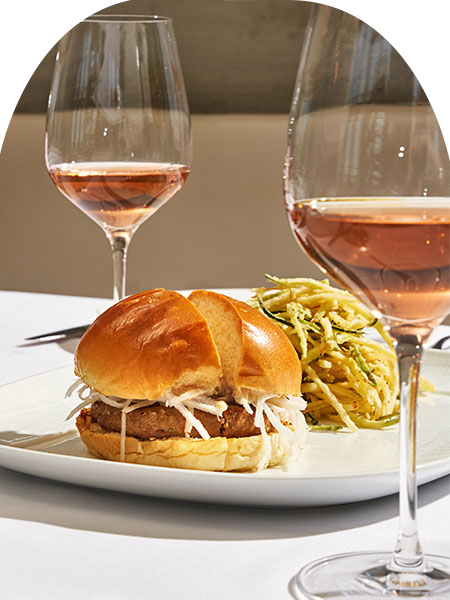
At Milos, Manousakis finds the wine has a clarity unique among xinomavro rosés, as well as something a little extra. “Beyond the classic characteristics of xinomavro—the cherries, the aromas and the acidity—what I love about this wine is an underlying spiciness,” he explains. The wine is pale and clean, on the restrained end of the xinomavro rosé spectrum, yet that savory undercurrent gives it the power to stand up to robust dishes. “Pair it with anything tuna, whether tartare, sashimi or grilled,” he says, “But for me the ideal pairing would be the tuna burger.” Seasoned with sesame oil and dressed with spicy daikon radish and a mustard-infused aioli, it’s not shy in flavor—but then again, neither is xinomavro rosé.

is W&S’s editor at large and covers the wines of the Mediterranean and Central and Eastern Europe for the magazine.
This story appears in the print issue of August 2021.
Like what you read? Subscribe today.