Umami is having its moment. Once referred to with a note of mystery and skepticism (the “so-called” fifth taste), the savory flavor is now so accepted it’s sold in tube form (Taste #5 Umami Paste, available at deandeluca.com) and as takeout, at 22 Umami Burger outlets.
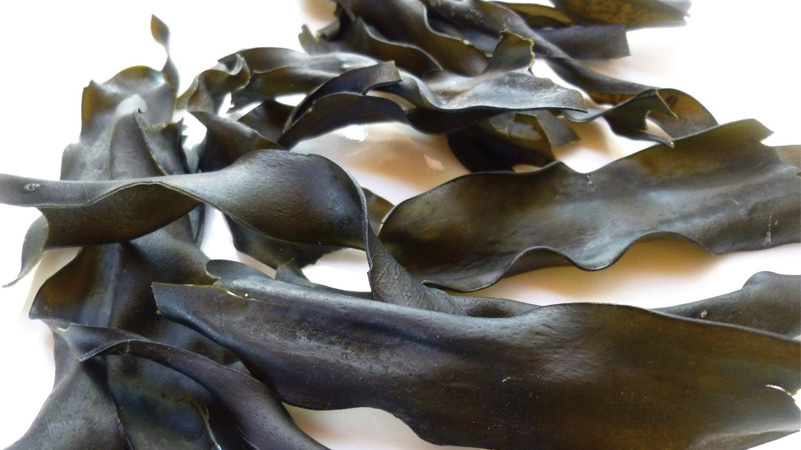
It’s also been cropping up in wine tastings, used perhaps in the same way old British wine writers once used “brothy” and “bouillon” (back before cubes, when bouillon was made from roasted bones). It’s what the 17th-century gastronome Jean Anthelme Brillat-Savarin termed “osmazome,” and what in 1908 the Japanese chemist Kikunae Ikeda named “umami,” a contraction of umai (delicious) and mi (taste), after he’d managed to isolate the compounds responsible for it from Laminaria japonica, a seaweed used widely in Japanese cooking.
In fact, you might note umami in aged wines, and in those with extended lees contact (like Champagne). But it’s a far more significant player in sake, where it’s considered an integral component of quality.
So when the chance came up to go to Kyoto this past fall, I took it. Around Kyoto, umami matters when it comes to choosing something to drink.
Dashi: The Basis of Japanese Cuisine
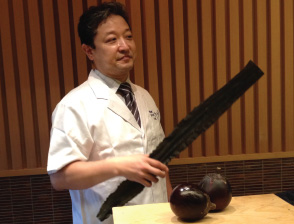
In the kitchen of Jikishinbo Saiki, chef Mitsuru Saiki runs a skimmer along the top of a cauldron of broth. “Japanese cuisine is a cuisine of subtraction,” he says. “We are always skimming, always taking away, not adding.”
Saiki is making dashi, a broth imbued with kombu, the dried version of Laminaria japonica. Dashi, he explains, is the basis of Japanese cuisine, and although the recipe seems simple, making it well requires careful attention. The quality of the kombu itself is critical: Most kombu is sold after six months of drying; the good stuff, he says, is at least a year old; he prefers two-year-old, or even older when he can afford it.
he difference, he explains, is the level of glutamic acid. Glutamate is the amino acid most directly associated with umami—the one Ikeda isolated from kombu, and proceeded to turn into Ajinomoto, an industrially produced version more commonly known as monosodium glutamate, or MSG.
In its natural form, glutamate is one of the 20 amino acids necessary for life, and appears in all sorts of foods, from potatoes to carrots, peas, spinach and walnuts. Fermentation and drying heighten glutamate levels, not only through the concentrating effects of dehydration, but also due to chemical reactions within the foods.
“Wine has acidity; and high acidity is fatal for Japanese dishes,”
—Chef Mitsuru Saiki
While dashi can be made with kombu alone—in fact, Saiki points out, the kombu-only version is integral to Zen Buddhist shojin cuisine—the ultimate umami expression comes from the comingling of sun-dried bonito tuna, called katsuobushi, and kombu. “As the katsuobushi ages, the proteins are turned to inosinic acid,” Saiki explains, as he releases a shower of feathery katsuobushi flakes into the kombu stock, swirls them around gently, and then strains the liquid. “It’s the combination of glutamic and inosinic acids that’s at the core of Kyoto cuisine; the synergistic effect they have creates a fullness of flavor.”
To demonstrate the power of the pairing, he offers a small cup of kombu stock next to the kombu-katsuobushi stock. The difference is stunning: The first is light and seaweedy; the second tastes dark and rich. Then he adds a slice of matsutake mushroom and a small boiled fishcake to the broth and tops it with a sprig of kinome, a local herb, creating a baritone symphony of autumn flavor. “No calories,” he says. “Yet it stimulates the central nervous system and makes you feel full.” This is one of the reasons the Japanese still boast an obesity rate of less than four percent (in the US, the rate is 27.2 percent), he says. While Westerners look to fat to create richness, the Japanese use umami.
In Saiki’s view, it’s one of the reasons sake often works better than wine with Japanese food. “Wine has acidity; and high acidity is fatal for Japanese dishes,” he says, explaining that it can slay the umami character. When he’s looking for wine to match umami-rich dishes, he reaches for lower acid ones; Rhône whites instead of crisp chardonnays, for instance. After pulling a slice of dashi-brushed eggplant off the grill and placing it in front of me, he pours an Alain Paret Côtes du Rhône Valvigneyre, a partially barrel-fermented viognier, alongside a glass of Hinodezakari from Matsumoto Sake Brewing. Both the sake and the wine are rich and round, gentle and soft, but only the sake truly harmonizes with the dish. It’s not just the acidity—the viognier feels pretty low in that department anyway. It’s the sake’s umami.
Drinking Umami
Autumn mornings in Kyoto are rich in umami scents: soymilk boiling and tofu grilling in an open-fronted store; dashi wafting from restaurants prepping for the day; chestnuts roasting. Headed south of the city, toward Fushimi, I arrive at Matsumoto Sake Brewing, a medium-sized producer run by the ninth generation of the family, Yasuhiro Matsumoto. He greets me with a bowl of hot, foamy matcha in a knubbly, handmade earthenware bowl. The matcha is intense, the density of powdered green tea leaves whipped into the water giving it volume and heft. It’s an early-morning hit of caffeine powered by umami—in this case caused by theanine, an umami-rich amino acid that’s abundant in young tea leaves.
Unfortunately, this autumn has been so warm that they haven’t yet started brewing sake (a trend, Mr. Matsumoto notes, that’s become increasingly frequent over the last decade), and so, after the tea, we head directly to the tasting room. “Please, taste the water first,” he suggests, which, I assume, is to rid my mouth of any lingering taste of the matcha. But no; he urges me to really taste it, roll it around in my mouth like a wine and feel it. “Eighty percent of sake is water, so the quality of the water is of paramount importance,” he explains. It’s not just the purity of the flavor, he says; it’s the texture. The very low minerality of Fushimi water gives it a very soft texture; sake brewers often describe Fushimi sake as “feminine,” as opposed to sake from places such as Niigata, where the water is harder.
Intriguingly, while there’s no actual umami in the water, the sensation of fullness it offers is not unlike that of dashi: clear and calorie-free, yet substantial. Thus primed, Matsumoto begins pouring sake. “Sip, roll, swallow: This is how you taste sake,” he says. What you’re looking for, he instructs, are sensations that engage five senses: sweet (from glucose); sour (from yeast); salt (or astringency); bitter (from alcohol) and umami (from amino acids).
“The best sake lasts on umami flavors,” he says. “Good sake sends a signal to the brain that tells you it’s good; this in turn causes your body to produce adrenaline and hormones, which is good for you; this is why they say sake is good for your health.”
But, Matsumoto says, if some umami is good, more is not necessarily better. The umami in sake comes primarily from succinic acid, which gives an earthy flavor and a weightiness to the wine; too much and the sake tastes coarse and heavy. And sometimes a lighter sake is simply more desirable: About five years ago, Matsumoto began working with Yasuhiro Sasajima, the chef of Il Ghiottone, an Italian restaurant in Kyoto, to develop a lighter, crisper sake that would both accent the freshness and lightness of vegetable dishes as well as echo any umami tones present (he uses dashi in many of his preparations, as well as traditional Italian ingredients high in umami such as Parmigiano Reggiano and tomatoes). Matsumoto pours some of this sake, called Rissimo. “We went with Aiyama rice, a very rare rice grown in the Hyogo Prefecture, that gives a sake with higher acidity, and fermented it longer and colder than our other sakes,” he explains. In general, the longer the fermentation, the more time for umami to develop, while the cooler temperatures help retain the acidity. The end result comes off as bright and light with citrusy tones—almost wine-like in its structure—yet it lasts on umami, making me wish for lunch.
Wine vs. Sake
Grabbing a friend on the way, I head to Restaurant Tamura, run by a chef who specializes in French-influenced Japanese cuisine.
Taking two of the nine seats at the bar, we can clearly see the grape-bunch pin the chef wears on his jacket, and the fortune’s worth of wine stored in the glass-sheathed fridge behind him. When I ask how to decide when to go with sake and when to opt for wine, he asks if we might allow him to present a flight containing both, pouring three whites and two sakes to start.
Despite his deep selection of international wines, Tamura chooses three whites from Japan—Takahata Pinot Blanc, Yawata Chardonnay and a koshu from Soleil Winery. Koshu, he says, is a variety known for its sake-like aroma and low acidity, which makes it popular in sushi restaurants in Japan. “In general, you could say that Japanese wines are more reserved than others,” Tamura says. “They may not be complex, but Japanese cuisine based on dashi is already complex; you don’t want a beverage that’s going to compete.”
“The best sake lasts on umami flavors.”
—Yasuhiro Matsumoto
The sakes seem to follow in a similar vein—a round, floral Kikusui from Niigata and an earthy, dry, umami-rich Dewazakura from Yamagata. That is, until the first dish hits. It’s chawanmushi, a classic Japanese egg custard to which he’s added hamo, a local fish that’s just going out of season, and crab, which is just coming into season. The custard is light and smooth as silk; the hamo is earthy, the crab is sweet, and fresh ginger adds a quiet zing. None of the wines make the cut; as reserved as they are, they feel like an added ingredient, whereas the sake—Dewazakura in particular—melds into the dish, becoming more like an echo than a counterpoint. It leaves us to contemplate the profundity of the dish, a composition carefully drawn to capture a particular moment of the year.
Sake wins the next round as well—unfair, perhaps, since it’s a selection of small dishes meant to celebrate the season, which, Tamura adds, are generally considered shu-ko, or dishes to have with sake. There’s a riff on the classic Kyoto mackerel sushi, marinated in vinegar, and saura, another seasonal fish, with an earthy-sweet glaze of miso, as well as a bright, crunchy salad of edamame and mountain yam. Interestingly, it’s not just the range of flavors presented by the plate that drives it toward the sake; it’s the clarity and precision of each bite. The sake doesn’t compete with this; rather, the mouth-filling textures and quiet flavors provide a backdrop.
The balance begins to change with the next dish, an arrangement of eggplant, buckwheat and clam with multiple seasonings; suddenly, the sake is getting lost. “Now we’re going into more complex flavors,” he says, “which means we’re heading into more complex wine territory.”
His point hits home when he sets out a miniature Dutch oven filled with beef stew alongside a glass of red wine. It’s not simply that it’s a beef dish—there are plenty of meat dishes that match well with sake, Tamura points out. It’s that it’s essentially a French dish in construction. “In French cuisine, the point is to add ingredients to come up with flavor,” Tamura explains. It’s the exact opposite of the philosophy that chef Saiki described as he was skimming the kombu stock: Japanese cuisine is built on the idea of taking away, revealing the essence of something by paring it back, accenting its inner deliciousness. The different structures call for different approaches when it comes to what to drink; in this case, the layering of flavors, of richness on richness, creates a volume sake can’t attain—not to mention a desire for the relief of acidity and tannins that a glass of red wine can provide.
Aged Sake
A trend toward lighter, brighter sakes becomes clear after a few days of ambitious tasting around Kyoto; at one brewery, nearly the entire range of sakes has been updated to reflect that trend, the offerings crafted with lower alcohol, higher acidity and fleeting finishes. There are also carbonated sakes, yuzu-flavored sakes, and sweet sakes packaged in pink bottles. These are sakes for social drinking, where, apparently, our internal umami meters are turned off.
But I’ve heard about one brewery that’s taken an opposite direction, adhering to an approach so traditional that it claims its own rice fields. So on my last morning in Kyoto, I take the bus back to Fushimi, to visit Tokubee Masuda, who makes sake under the Tsukinokatsura brand.
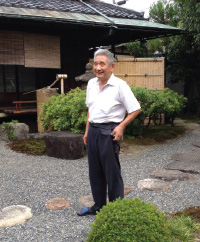
His brewery—the oldest in Fushimi, founded in 1675—is barely noticeable from the street, a low-slung building on a residential strip. Mr. Masuda, a slender, nattily dressed man, is waiting for me, immediately recognizable by his thick mustache. As both a brewer and the chairman of the Japanese government’s Overseas Sake Promotion Committee, he’s keenly aware of the challenges the sake market is facing today. “Right now, there are 1,500 sake brewers in Japan—that’s a third less than there were just forty years ago. And breweries continue to disappear. In the old days, breweries had their own farm land, their own techniques,” he says. “Today, the rice can come from anywhere, and techniques are shared from north to south. The tendency of breweries today is to make their sakes more distinguishable.” What this means, he says, is that flavor becomes the driving characteristic of the sake, not texture and feeling. Umami, in essence, doesn’t rank highly in the list of desired characteristics.
This is convenient for industrially produced sake, since shorter fermentation periods produce less glutamic acid; an industrial product can ferment in half the time it takes to make a yamahai or kimoto sake, more traditional methods that eschew the now-common addition of lactic acid to both speed things up and discourage wild yeasts.
For himself, Masuda isn’t looking to save time. He started growing his own rice 23 years ago, inspired after a trip to Burgundy and Bordeaux, when he was struck by the concept of terroir. He now has three additional parcels farmed in agreement with local growers, all organically raised. When the rice comes in, he soaks and steams it in a pit heated by an ancient furnace, then spreads the swollen grains out on small cedar trays (rather than the massive metal beds more commonly used today) held in a humid cedar-lined room to turn into koji, the aspergillus mold-infected rice that kicks off sake fermentation. It’s a slow, laborious process that continues incrementally until fermentation finishes.
Japan is the only country in the world to have developed an entire cuisine based on umami. Because of it, in combination with other cultural factors, washoku, or traditional Japanese cuisine, may well have been added to UNESCO’s Intangible Cultural Heritage list by the time you’re reading this; in late October, the organization’s preliminary review panel had already recommended the addition, a move expected to be finalized by the end of December.
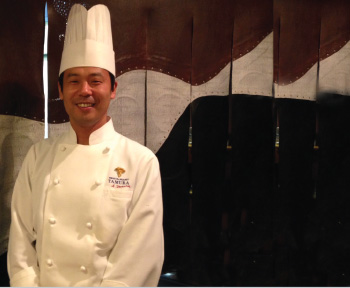
“Japanese cuisine based on dashi is already complex; you don’t want a beverage that’s going to compete.”
—Chef Shogo Tamura
He shows me a cache of earthen vessels, stored at the top of the brewery. Each 20-liter jug is filled with premium sake—made from Yamada Nishiki rice, which he calls the “king of rice,” polished to 35 percent of its original grain size (placing it in the junmai daiginjo category)—and left for a decade. This is koshu, or aged, sake, a style his father began making in 1966. It wasn’t a new idea, ha says, though it was considered radical at the time. “Almost 300 years ago sake brewers were aging their sake. My father took the idea from an old book about fermented foods.”
After we head back downstairs, he pours a glass of a ten-year-old koshu. It looks like a light whiskey in its pale caramel hue and has a scent similar to smoked Gouda and roasted nuts; in flavor it’s earthy and smoky, lasting on its satin-smooth texture. It’s the polar opposite of the modern, clean, bright sake model, while it manages to have more in common with wine than any sake I’ve yet encountered. And yet it also reads clearly as sake in its quietly enveloping umami tones.
This story appears in the print issue of February 2014.
Like what you read? Subscribe today.