COVID-induced smell loss could take away the pleasure of wine, but new research shows that, in some cases, smell training might bring it back. Beyond its effectiveness as a recovery tool, could this olfaction-enhancing training be useful for wine professionals?
I remember Friday March 14, 2020, very well. It was the day that I had my first COVID symptoms and, for a while, I thought I might have to find a new career.
It was early in the days of the pandemic, before everyone realized exactly how much of a problem COVID was going to be. I’d returned to London the previous week from a trip to Japan. This was to be my last long-haul travel for a while. On Monday, there had been a big Washington State wine tasting, followed by a party with live-band karaoke. These were, of course, ideal conditions for viral spread. Then on Wednesday, I caught up with a couple of winemakers from New York State. Friday was to end up being my final day out for many months. It began with a tasting with the winemaker at an urban winery in London, then a visit to the Warhol exhibition at the Tate Modern with a friend, followed by tapas and Fino Sherry at Brindisa.
I knew something was wrong before the evening was out, and the following day I was sick. I spent a few days sleeping a lot, aching and lethargic. But I experienced the most alarming symptom when I poured a glass of wine: it tasted very strange, indeed.
It wasn’t for a while that talk of COVID-induced loss of smell (or alteration in that sensory function) began to emerge, and several months before this was officially recognized as a symptom (in the UK, in May 2020). So, I had no idea that this was something many people were experiencing. I spent two weeks being unable to taste wine: I hadn’t lost my sense of taste, but it had been altered sufficiently that trying to taste was a waste of time from a professional standpoint; all the wines I tried tasted so bad I didn’t want to drink them. And I was concerned: if this doesn’t go away, I said to myself, I’m going to need a new career.
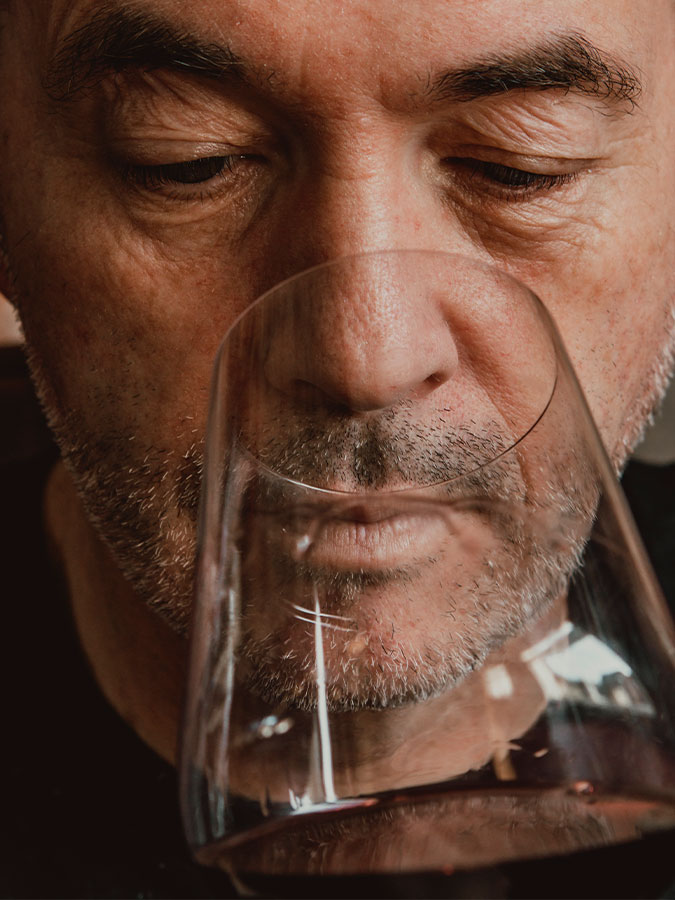
Smell is a sense that we tend to take for granted. But its loss can be devastating, and not only for those who use it professionally. It adds a great deal of color to life, and those who have become anosmic—the medical term for losing the ability to smell—frequently report feeling depressed. The pleasure that comes from food and drink is lost without smell—what we think of as “taste” is actually a multimodal sensation that has a lot of input from smell, as well as from taste itself, touch and vision. All the time, smell is there, working in the background, and we often only notice its significance by being deprived of it. There are also safety implications in not being able to smell food that has gone off, or a gas leak, or smoke from an unintended fire.
“Deliberate smelling is a bit like going to the gym for your nose.”
How Widespread is Smell Dysfunction?
From the relatively few surveys looking at its incidence, smell loss—whether it is partial or complete—is more common than most people realize. There are three terms that describe the different sorts of damage to this sense. The first is anosmia, the loss of smell. Then there’s parosmia, which is a distorted sense of smell in the presence of an odor source: things no longer smell the way we are used to them smelling. Then there are phantosmias, which are smells in the absence of an odor source.
Around one in 10,000 people are born without any sense of smell. But it is much more common for people to lose this sense, either partially or completely, through accident, disease and aging. Head trauma is a common way for people to become anosmic, because the nerve cells that detect smell molecules—called olfactory neurons—pass through a structure called the cribiform plate in the skull, and a rapid jarring of the head can cause these to shear off. Famously, in the wine world, this happened to the UK wine merchant Harry Waugh. In a review by researcher Thomas Hummel and colleagues, they found that the prevalence of olfactory loss was reported as 22 percent in 25- to 75-year-olds in one study, 19 percent in people over 20 years old in another, and 24 percent of those over 50 in a third. This isn’t complete loss in all cases, but rather a significant impairment. These figures are based on testing: Studies that rely on self-reporting show lower figures, because many people don’t realize that they’ve lost a lot of function if this diminishment in smell ability happens gradually.
What about the effect of aging? Back in 1984, a study by Richard Doty and his colleagues examined 1,955 people aged between five and 99. The peak performance was between the ages of 30 and 50, and declined markedly after the age of 70. After the age of 80, three-quarters showed major impairment. Another study from 2002 looked at 2,491 people aged 53 to 97. Overall, 24.5 percent had impaired olfaction. Of those over 80 years old, 62.5 percent had impairment. Interestingly, the self-reported figure for impairment was 9.5 percent.
COVID-Associated Smell Loss
Though it took a while for smell loss to be recognized as a common symptom of COVID, we now know that around half of those with COVID lose their sense of smell, while many others experience parosmia or a degree of smell loss. The good news is that almost 90 percent recover most of this function within four weeks. However, for a subset of people, the news is less good: the dysfunction in smell is long-term. This is an alarming prospect for anyone, but particularly for those who use their sense of smell professionally. For many of the long-term smell-disturbed, the loss is complete. For others, smell comes back after a while but in a distorted form, where things don’t smell the way they should. This is also upsetting for those involved.
The mechanism behind COVID-induced smell loss isn’t completely clear, but a series of deductions have led scientists to think that the virus is affecting the sustentacular cells in the olfactory epithelium that play a supporting role to the olfactory receptor cells, which themselves are specialized neurons. The virus SARS-CoV-2 attacks cells by targeting a receptor on their surface called ACE2, and the olfactory neurons don’t have these receptors, while sustentacular cells do.
As well as smell loss, COVID is also implicated in dysfunctions in taste. This is a little complicated to separate out, though, because infected people could lose their sense of smell and then report that their “taste” (which is a combination of taste, smell and touch) is impaired. It does seem to be a side-effect of COVID, although no one has a handle on the mechanism yet.
Why This is Concerning
As a wine professional, I’m concerned about contracting COVID again. According to the statistics, there is a good chance that if I do, I will experience some smell loss; I could also experience some loss of taste. All of this is worrying because a lot of my work involves tasting, describing and assessing wine. Aside from this, wine is my hobby, and I derive a lot of pleasure from it—as do many of the readers of this magazine, I would imagine. I was lucky last time: my sense of smell returned to normal. But what if I were to be one of the unlucky ones with long-term loss or disturbance? As COVID moves from pandemic to endemic, we are being told that we have to live with this virus, and treat it much like the flu—with the current restrictions aimed to limit its spread removed. Those of us working as professionals where smell is vital to our jobs will feel like we are now in a lottery situation: if our number comes up, it’s the end of our career.
Prospects for Recovery
There is, however, a glimmer of hope. While smell loss is permanent for some, it seems that for many there are things that can be done to hasten the recovery of function. Smell turns out to be quite a malleable sense. Our olfactory neurons are the only part of the nervous system that is able to regenerate, and these cells regenerate every six weeks or so. A clue that recovery of function is possible came from the work of Charles Wysocki and colleagues, in 1989, on the way people smell a compound called androstenone. This is an odorous steroid derived from testosterone, and it acts as a pheromone in pigs. It’s found in high concentrations in the saliva of boars. People differ in their ability to smell it: around 40 percent of people can’t smell it at all, while some find it sweaty and urinous (unpleasant), and others find it sweet and floral (pleasant). Wysocki was working on this compound, and although initially he couldn’t smell it, he later found out that he was beginning to be able to detect it. His sense of smell was changing. This prompted further study. He examined people anosmic for androstenone and found that with repeated exposure, many of them acquired the ability to smell it. Further studies showed that an olfactory receptor called OR7D4 was responsible for the ability to detect this compound. It could be that repeated exposure to androstenone leads to increased expression of this receptor in the olfactory epithelium, or to an increased ability of the brain to make sense of the message being received from this receptor.
A trawl through the scientific literature suggests that deliberate smelling is a bit like going to the gym for your nose. In a study from 2004, Hummel and colleagues looked at people working in perfume outlets. They suspected that if someone works in a very smelly environment, their sense of smell might be dampened down, or overwhelmed, in some way. But they found that these workers were actually better at odor discrimination because of their job, which involved lots of smelling. Another study in 2010 by Franklin Mariño-Sánchez and colleagues looked at whether training in wine tasting made a difference to the ability to smell. They took 21 students and staff from the oenology school in Tarragona, Spain, and compared them with 41 control subjects, using 20 different wine-related odors. They scored similarly in actually detecting odors, but the wine tasters were better at identification (naming odors) and also forced-choice naming (identifying an odor when presented with four possible answers that they had to choose among). An older study, from 1997, by Bende and Nordin, also looked at wine tasters compared with controls, and found that the wine tasters were no better than the controls on detection, but were better on discrimination and identification.
In an interesting study from 2011, Sophie Tempere and colleagues measured detection thresholds for 10 key odor compounds in wine in over 100 wine professionals. None were hypersensitive for all the compounds, and only three were substantially less sensitive for all of them (and two of these had colds at the time). But they did find specific anosmias for five of the odorants (these occurred at rates of two to five percent). For three of the odorants, 10 percent of the group were hypersensitive. Interestingly, for 2,4,6-trichloroanisole (TCA; the main cork taint compound) there was a hypersensitive group of eight percent of the population tested.
The study that is missing is tracking performance in the same person before and after training in wine. If students enrolling on an oenology degree were tested on wine-relevant aromas and then tested after the completion of their course, the results could be interesting.
The malleability of smell, and potential improvement with practice, has led to a new therapy for anosmia, called smell training. The idea is that people should pick a set of strong smells and then smell them regularly. Ideally, the scents used should represent the four smell categories of flowery, fruity, spicy and resinous. These could be things already found in your cupboard, or sets that are available for purchase. While this treatment has been used for several years, the COVID side effects have put a new focus on it, and studies show it seems to have some effect. “There’s good evidence that smell training leads to speedier recovery,” says Professor Barry Smith of London University’s School of Advanced Studies Centre for the Study of the Senses (CenSes). He’s the UK head of a consortium of smell researchers called the Global Consortium of Chemosensory Research (GCCR), formed to study this phenomenon of COVID-associated smell loss. But Smith emphasizes that this training is useful for all. “Smell training is also good as we get older to keep olfaction intact,” he says. He cites a 2018 study from Thomas Hummel’s lab with two groups of 70-year-olds: One did sudoku for three months and the other did smell training. “After that time, the sudoku group were better at doing sudoku but showed no other benefits,” he says. “The smell training group improved their detection of smell but also showed cognitive improvement. So, we should all be doing smell training as we get older.”
Interestingly, for wine professionals, this sort of training also improves olfactory function in people without impairments in the sense of smell. But if wine tasters are already tasting wine daily and focusing attention on its smell, is smell training going to have any efficacy in addition to the positive effects of the wine professional’s daily practice? It would be interesting to know the answer to this. The good news for wine lovers is that tasting wine regularly might be protecting against some of the loss that comes with age. “Interestingly, wine tasters and florists show less decline,” says Smith, “because they are using their sense of smell daily.”

Based in London, Jamie Goode is a lapsed scientist who now devotes his time to writing about wine, mainly in the UK national newspaper the Sunday Express, and on his own site, wineanorak.com. The author of The Science of Wine (UC Press 2014) and I Taste Red (2016).
This story appears in the print issue of Spring 2022.
Like what you read? Subscribe today.