At a banquet in Taipei earlier this year, William Stanton, former US ambassador to Taiwan, toasted T.T. Lee, the founder of Taiwan’s Kavalan whisky distillery, by reminding the group assembled around the table of the island’s unique accomplishments. “Remember,” he declared, holding up a glass of tawny spirit, “Taiwan is an island. It has no real natural resources except for the industriousness and ingenuity of its people. Yet they’ve achieved so much … including this incredible whisky.”
Kavalan created a sensation this year by winning the World Whisky Awards’ Best Single Malt Whisky, this on top of dozens of other accolades since its first release in 2008. The distillery, which was built in just nine months, has only existed for 10 years, yet its whiskies are trumping those that have aged 15, 20 and 25 years.
Mr. Stanton’s remark caused me to consider the fact that a disproportionate number of the world’s most significant spirits come from islands large and small. Gin from the island of Great Britain, whisky from Scotland and its small islands of Skye, Islay, Jura, Mull and Orkney; whiskey from Ireland and Japan; and of course the myriad styles of rum from the Caribbean. If you compare spirit production by area of landmass, islands produce at an exponentially higher clip than continents. Why is that?
One easy answer is that, in an age when all international trade occurred via sailing ships, islands were waypoints with convenient access to trade routes.
If you compare spirit production by area of landmass, islands produce at an exponentially higher clip than continents.
But maybe it’s also resourcefulness. With limited resources, islanders are forced to make the best of what they have, and usually it’s a concentration and a specialization on one ingredient. In Islay, Orkney and the Scottish islands, it was peated barley. In the Caribbean it was sugar cane.
In each place, thanks to a relatively high level of isolation, the spirits became fascinatingly unique and expressive: Orkney’s peat, incorporating decomposed heather, gives Highland Park a different disposition than Laphroaig, a product of Islay’s iodine and seaweed. In rum, Martinique’s French-style rhum agricole is a world away from Barbados’ English style.
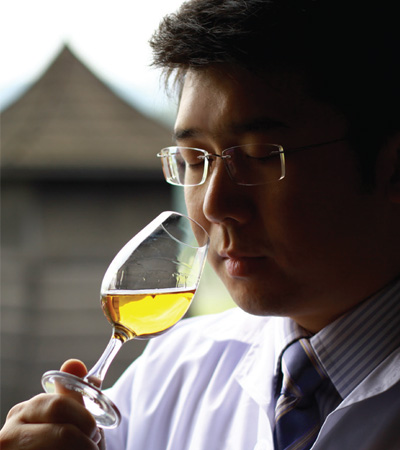
“We think whisky is a fusion of art and technology.”
—Ian Chang
Even in places like Japan, where whisky is based on Scottish technique, there is something inherently different about their results. Some of that can be attributed to the presence of Japanese oak barrels. But more than that is the level of restraint and detail in the best Japanese whiskies, from Yamazaki to Nikka to Ichiro. After over close to a century of production, the Japanese have found their voice. Scotch was the model, but in the end they created something that appeals to their own sense of delicacy and precision.
We are in the process of seeing the same sort of differentiation take place in Taiwan, though at a characteristically accelerated rate. Of the ingredients that make Kavalan what it is, its creators name technology first, climate second. “We think whisky is a fusion of art and technology,” said Ian Chang, Kavalan’s master blender, who attributes 70 percent of that fusion to technology, arguably Taiwan’s primary resource. This has allowed them to triumph over the challenge of making whisky in a sub-tropical climate. As Chang and his Scottish distilling consultant, Jim Swan, found, a traditional Scotch-whisky fermentation of malted barley yields a base spirit that can’t withstand the heat of Taiwan.
So Chang and Swan contrived a new ferment using specially engineered yeasts and other innovations that Swan wouldn’t reveal, to produce a richer, fruitier and more robust base spirit that could hold up to the rapid aging that happens in Taiwan’s climate. The goal was also to develop flavors they believed would appeal to the palate in Taiwan, which is the world’s fourth largest importer of Scotch whisky by value (after the US, France, and Singapore), and the fastest growing. The emphasis on fruit in the base spirit translates into subtly fruity flavors in the final products, with hints of pineapple, mango and guava (common in Taiwan) integrating with the mellow honey and toffee flavors imbued by Sherry barrels that recall those in Scotch whisky. And for aging only a few years, the integration and integrity of the whiskies’ flavors and characters is remarkable.
Taiwanese ingenuity has played a role in other ways. Kavalan developed technology to retool the barrels they were buying from Spain and the United States, allowing them to shave and re-char the barrels, eliminating residual sulfur and volatile acids leftover in the wood from the wines without sacrificing the Sherry, Port and whiskey flavors they held. And finally, they created a system for aging individual barrels of whisky evenly, given the different temperatures on the five levels of the barrel-aging warehouse. In a place where the goal is to slow down maturation rather than speed it up, the large-format casks—Sherry butts (500 liters) and Port pipes (600 liters)—go on the top floor, where summer temperatures can reach 110°F and conventional-sized 200-liter ex-Bourbon barrels sit on lower floors, where temperatures might hover around 80° F. It’s a hybrid between the Kentucky system, where Bourbon is aged in multi-floored hot warehouses (that nevertheless get cold in winter, unlike Taiwan’s warehouses), and uses only new American oak barrels, and the Scottish system, where whisky is aged in a cool, humid climate in several types of used barrels.
Ultimately, Kavalan’s makers have been able to make Taiwan’s hot, humid climate work in their favor. Given the growing global thirst for whisky, the satiation of which is inhibited mostly by the time required to properly age whisky, it’s easy to imagine that spirits producers might seek out other tropical climates in attempt to replicate Kavalan’s innovations. After all, there’s an ancient tradition of island distilling, and the seas are full of resourceful islanders.
Kavalan, Imported by Anchor Distilling, San Francisco, CA; Classic Single Malt (43% abv) and Concertmaster (40% abv), both $80; Conductor (46% abv), $110.

Jordan Mackay’s writing on wine, spirits and food has appeared in the New York Times, Los Angeles Times, San Francisco Chronicle, Decanter, the Art of Eating and many other publications. While Secrets of the Sommeliers, the book he wrote with Rajat Parr, won a James Beard Award in 2011, it’s certain winemakers that he credits with some of his most important tasting lessons.
This story appears in the print issue of August 2015.
Like what you read? Subscribe today.