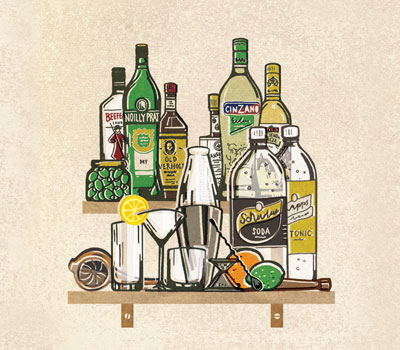
Given the latest crop of bar books, with their molecular mixology leanings, you might feel as though assembling a home bar requires a heavy investment of time and money, as you search for centrifuges, silver julep cups and ingredients like crème Yvette. But in fact you can put together a more-than-respectable setup for less than $100.
Spirits
In bartender speak, the “rail” is where we keep the bottles we use the most—not the top-shelf stuff, but spirits that pack value for money. Start with these.
Whiskey: Rye’s spicy notes give it an edge over other whiskeys when it comes to cocktails, as it balances any sweetness in the drink. At $18, Old Overholt Rye may be the best value on the liquor shelf for your Old Fashioned. For another $6, pick up a bottle of Cinzano Sweet Vermouth and you have the goods for a quality Manhattan.
Gin: London Dry. Juniper-forward with a background of herbs and citrus, it’s been a staple since people started spiking their anti-malaria medication and created the gin and tonic. Add simple syrup and fresh lime and you’ve got a Gimlet. At $14.50 Beefeater is probably the cheapest gin you’d want to stir with some Noilly Prat Original Dry Vermouth ($6) in a Martini. Just remember: Keep your vermouth in the fridge after opening, and use up within six months.
Garnishes and Mixers
Forget the cherries. Use olives in brine ($2.29) for Martinis; oranges for Old Fashioneds, lemons for Sours and limes for Margaritas and gin and tonics. For sweetening, make your own simple syrup by boiling two parts sugar to one part water until the sugar is dissolved; let cool and refrigerate. For longer drinks, pick up a liter of soda ($.99) and another of tonic ($1.29). When it comes to bitters, it’s hard to beat Angostura at $7.20.
Tools of the Trade
The most vital tool is a Boston Shaker tin ($2.99). Combine this with any pint-sized glass in your house and you have a personalized shaker set. For measurement, get a jigger ($1.99) with a half-ounce on one end and an ounce on the other. Next up is a muddler ($1.19) to press your mint or orange peels and a bar spoon ($.99) for stirring your more spirit-driven cocktails. Your average vegetable peeler will get you more citrus peel and oil with less pith than any fancy zester on the market. But if you want to take your Margaritas and Sours to the next level you’ll need a hand juicer ($3.19).
The Great Glassware Hunt
There are three types of glasses you’ll need: Old Fashioned glasses are usually less than 5 ounces, for drinking a small amount of spirit, 2 ounces or less. Highballs are the everyday workhorses. Most of us already have something like them in our kitchen: a short glass, the sort many people use for juice, about 7 to 10 ounces. Last is the cocktail or Martini glass, with a stem so your hands don’t warm the chilled drink. A wineglass won’t work as it will concentrate the heat of the alcohol, resulting in a powerful hit of alcohol when you smell it, but if you were looking for a reason to dust off those Champagne saucers in your closet, this is it. The best way to buy glassware is secondhand, slowly acquiring a unique collection.
This story appears in the print issue of June 2014.
Like what you read? Subscribe today.