On a snowy Sunday morning in December, vignerons from Vermont and neighboring states had gathered for a tasting of their latest bottlings at Bristol’s Holley Hall, a timber-frame and brick-veneer building, dating to the town’s logging boom in the 1880s.
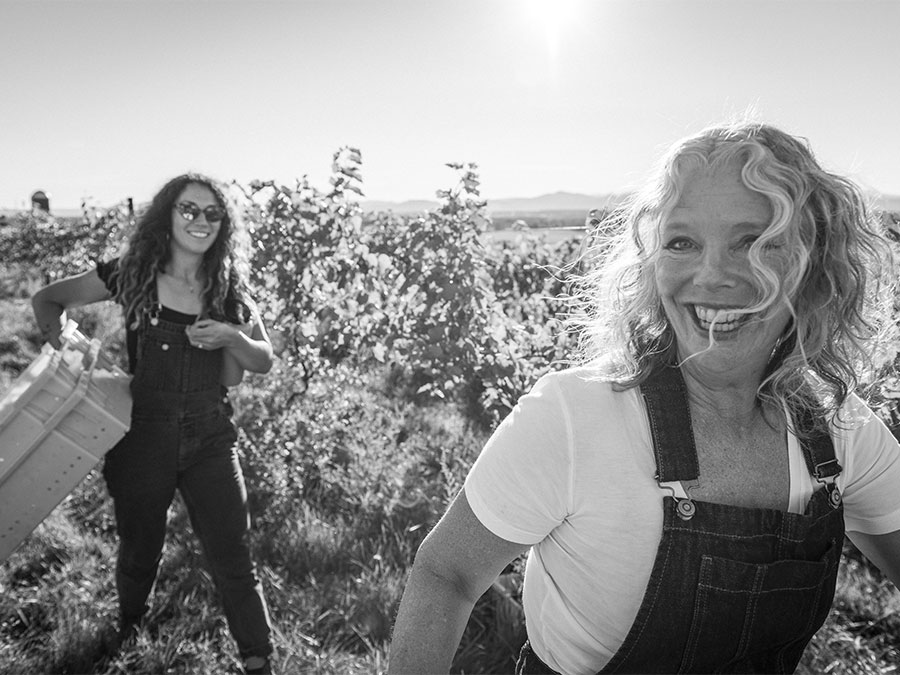
While the wines, ciders and meads were chilling, the participants were invited to attend a discussion on mentorship in winemaking. Deirdre Heekin, the artist behind La Garagista Farm + Winery, was sitting on the edge of the main stage in her dark-blue denim overalls, her feet dangling. She has been a mentor to nearly half of the young producers in the room, including her fellow speaker, Nico Kimberly (NOK Vino, NH). And though she would have a lot to say on the subject, she was listening instead, a knowing smile on her face.
That mentorship led Kimberly to “follow a blueprint of how Deirdre is working,” he said. He’s never had such a collaboration in his home state of New Hampshire, where he finds that protecting trade secrets is more the norm. In a way, Vermont’s wine scene resembles its birthplace: close to nature and built at a human scale, with a strong sense of community.
Then Heekin spoke up. “A a mentor, you can’t have those reservations,” she said. “Instead, you need to be open to share your ‘trade secrets’ and know that your mentee will apply that in their very individual way.” And that’s just what they do: Three of Deirdre’s protégées—Camila Carrillo of La Montañuela, Willa Deeley of Disciple and Anna Travers of Lilith Wine—are now seen as Vermont’s rising stars.
Later, at the tasting, Kathline Chery poured me a glass of a fresh and fruity red wine from Marquette and petite pearl. She had recently co-founded Kalché Wine Cooperative—a collective cellar producing wine, cider and beer in Fletcher, 30 miles from the Canadian border. Speaking of mentors, she said, “I don’t know how people run their first vintage without the help of their neighbors. But that help is priceless—and it’s just a text away!”
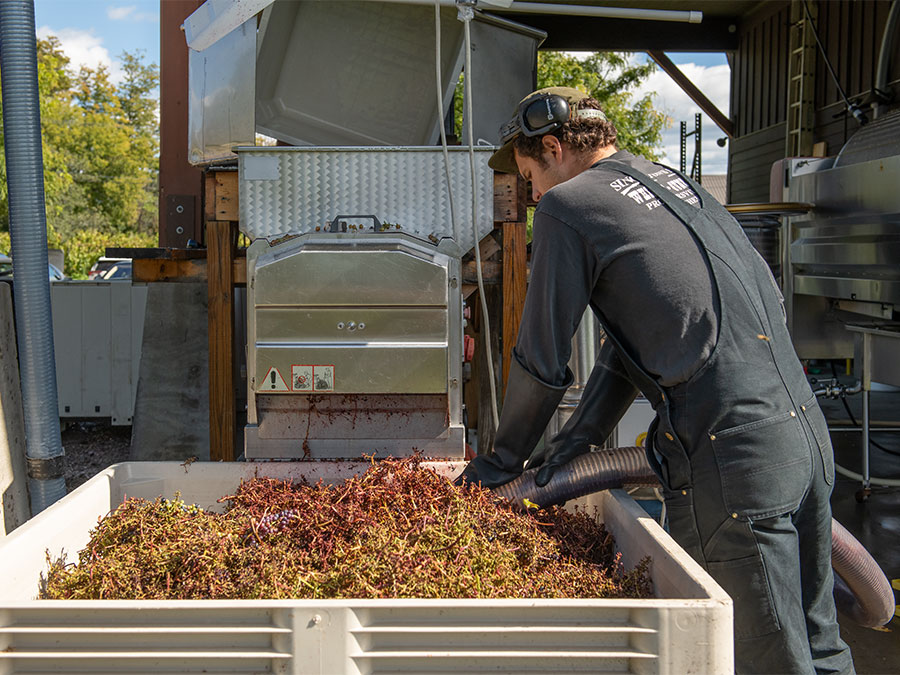
One of Chery’s neighbors is Ethan Joseph, who has been making wine since 2007 at Shelburne Vineyard and has helped many new winemakers in their journey. Last September, when I arrived at the understated and elegant winery that borders Route 7, south of the small town of Shelburne, Joseph had just finished pressing some of the harvest from La Crescent. The fresh juice, made from very ripe grapes, appealed with its aromatic intensity. The Marquette grapes beside the cellar were also very ripe—delighting the swarms of bees that day—but the harvest would have to wait a few more days, due to staffing. Nature may be harsh under these latitudes, but its sudden generosity can also take you by surprise.
TILL, SLATE AND SUN
Winters are notoriously cold in Vermont, and the region regularly sees temperatures below -4°F. Over the past sixty years, however, winter temperatures have increased 2.5 times faster than average annual temperatures (2°F), and annual precipitation has increased an average of 1.4 inches per decade. The frost-free period increased by three weeks and spring thaws arrived earlier, lengthening the growing season. Extreme weather events such as droughts and floods are also on the rise, unfortunately, and Vermont now faces more days of heavy precipitation.
The landscape as we know it today was shaped during the Quaternary glaciations, when the northeastern United States and Canada were buried under massive ice caps, which covered even the highest peaks of the Green Mountains and Adirondacks. The vine finds fertile and diverse soils, sedimentary layers of clay with an abundance of calcium, born of the retreat and melting of these glaciers.
Lake Champlain, particularly on the Vermont side, is flanked by a vast plain of glacial till. There are some intrusions of igneous rocks from the Canadian Shield along with aquiferous sediments (limestone, marble, dolomite and sandstone) of variable thickness. Add to that fragments of Vermont’s famous green slate, and you have a pretty mosaic.
BUILDING ROOTS
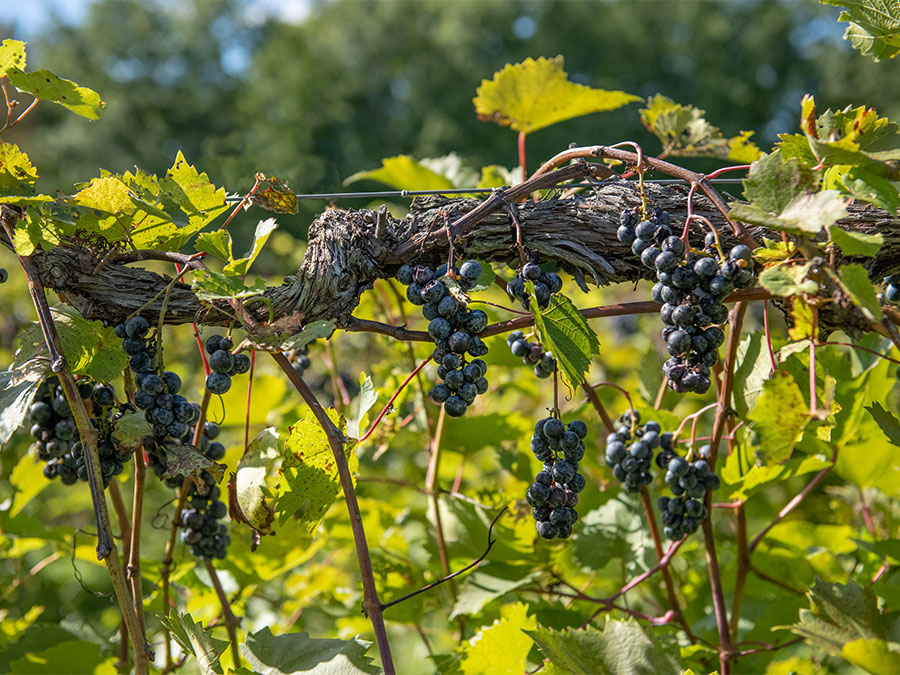
The beginnings of viticulture in Vermont were in many ways similar to those in other parts of the American Northeast. The first plantings, interspecific hybrids developed in France, failed to thrive in the harsh winter cold of the Green Mountain state. Now Vermont’s largest grape grower with 22 acres of vines, Shelburne Vineyard began in the mid-1990s with a handful of hybrid vines that its owner and founder, Ken Albert, planted behind his home. The first larger-scale plantings came in 1999 at Meach Cove Vineyard with Illinois hybrid traminette as well as the Austrian zweigelt, which also proved too fragile for Vermont’s winters and was replaced with vidal blanc. Today, hybrids developed in Minnesota and bred specifically to survive winter frosts produce most of the state’s wines.
Vermont’s distinctive wines, however, don’t rely so much on the North American hybrids as on their “interpretation” by the vignerons. As Matthieu Beauchemin at Domaine du Nival points out, Quebec wines made from the same hybrids underwent a similar evolution. “As long as winemakers tried to please the masses [with oaky, sweet and low-acid red wines] they were doomed.”
For a time, many winemakers tried to emulate California wines. “Not only was it a strenuous path in the winery, but the wines were very difficult to market,” he says, crediting the wines at La Garagista as having led in the opposite direction, offering an unapologetic expression of American hybrids.
“By targeting the right customers with the right wines—natural, with a good acidity and sometimes slightly atypical aromatic profiles,” Beauchemin notes, “Deirdre has put hybrid wines on the map.”
Heekin and her husband, Caleb Barber, began experimenting with hybrid grape varieties in the early 2000s at their farm in Barnard, a small town nestled in the Green Mountains about 20 miles, as the crow flies, west of New Hampshire. In 2010, she and her friend, Eleanor Léger of Eden Ciders, launched the first of a series of cider aperitifs inspired by concoctions like Chartreuse and Italian amari. Grape ferments followed shortly after. “Her wines immediately had a unique identity,” recalls Montreal sommelier Vanya Filipovic, who grew up in Barnard, where her parents owned a restaurant. Filipovic, who imports Vermont wines, beers and ciders to Quebec, points out how Heekin pioneered skin maceration with white grapes like La Crescent, demonstrating the potential of hybrids to produce balanced wines.
BLURRED LINES
Part of Heekin’s brilliance is her ability to build strong and hyper-stimulating networks around Vermont’s hybrid wines. “At first, she made 70 cases of wine a year,” Filipovic says, “and she shared them with those who could understand, exchange, and open discussions around her work.” That helped her gain traction in major markets, like New York City, even as she became a unifying figure in Vermont’s wine community, Beauchemin adds. “Deirdre took young winemakers under her wing,” he says, “while respecting the work of those who preceded her, like Ethan.”
Ethan Joseph began working part-time for Shelburne Vineyard while studying natural resources at the University of Vermont. When a full-time job opportunity came in 2008, he dove in. The first cuvées he vinified responded to consumer demand for full-bodied wines. The age of the vines and the experience acquired through multiple experiments have improved the quality of the harvest and the wines, one vintage at a time. This “methodical and rigorous” evolution, to use Beauchemin’s words, led to the creation, in 2018, of Iapetus, a project dedicated to the development of natural wines, ciders and piquettes. With his Terrane cuvée, Joseph even has fun mixing genres, adding a touch of piquette to the blend of Marquette and petite pearl rosé “to lighten things up.”
The lines between wine, cider and other fermentations of honey, sap and berries have continued to blur over the last few years as winegrowers find imaginative ways to use local crops. At Fable Farm Fermentory, in Barnard, brothers Jon and Christopher Piana have made unusual co-fermentations their business model. While some bottlings like Emanation (a dry cider) and Elder Dandy (honey and apples) remain on the classic side of the spectrum, others like Betula explore uncharted territories, merging birch sap-water, raw honey and whole clusters of foraged sumac berries—a sour, funky and distinctive expression of mead.
The table wines are a little more classic at Ellison Estate Vineyard, but Kendra and Rob Knapik’s artistic flair is expressed in other ways, from the fields to the pretty labels that look like vintage wallpapers. Kendra, a self-confessed “wine-geek,” is a veterinary oncologist; Rob is a particle physicist. The Grand Isle property they purchased in 2018 features 10.5 acres under vine, one of the largest contiguous vineyards in Vermont, planted between 2005 and 2010. They are planting four additional acres this spring. Sheep roam freely, enjoying, perhaps, the views of Lake Champlain. The couple, parents to three young children, approach their new career as farmers with a scientific rigor, dedicated to restoring the balance of this centuries-old agricultural land through organic and biodynamic farming practices, and regenerative agriculture. At harvest, they process the grapes in their basement winery in Stowe and produce a wide range of deliciously pure and focused wines. La Coccinelle et La Guêpe, a red, might be the most elegant expression of St. Croix I have ever encountered. For a wilder (yet clean and transparent) take on hybrids, one should explore the Regeneration range (#1 to #6) of pét-nats, featuring Marquette, St. Croix, Frontenac Noir, Louise Swenson and La Crescent.
The weather may be harsh and the growing season short, but hybrid grapes are thriving in Vermont. The opportunities they offer have few parallels in the traditional world of vinifera vines, allowing the creative impulses of the local growers free rein. Looking across the border from Quebec, it seems as if Vermont’s free-spirited artisans have transformed what was once a blank canvas into fall harvests of magnificent colors, continuing to nurture new talents along the way.

Quebec-born Nadia Fournier has been reviewing wines for 15 years in Le Guide du Vin, a Canadian bestselling annual, as well as co-hosting the Les Méchants Raisins podcast and writing a weekly column for LACTUALITE.COM and Le Journal de Montréal.
This story appears in the print issue of Spring 2023.
Like what you read? Subscribe today.