In light of the Paris 2015 UN Climate Change Conference taking place from November 30 to December 11, and its goal of reaching a universal agreement on climate from all nations, we’re taking a look back at climate-focused articles from the pages of the magazine.
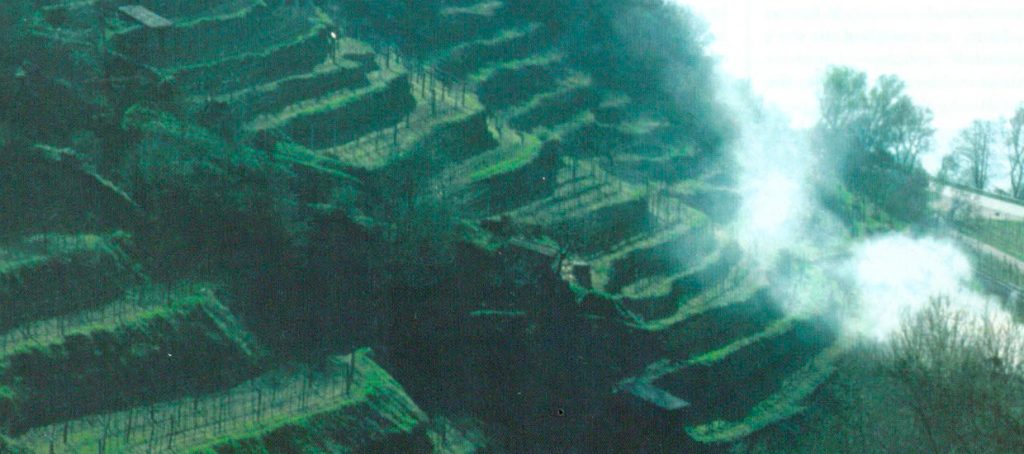
Traveling Europe’s German-speaking riesling regions, I increasingly hear this new refrain: “Die Natur spielt verrückt’ (Mother Nature is acting crazy). Most climatologists, and increasingly many vintners, believe gradual warming is a long-term trend and that there is no retreating from its effects. Nonetheless, a literal retreat to higher ground might extend the life of fine wine as we know it into the next century. A few intrepid vintners are testing that hypothesis with fascinating and delicious consequences. To appreciate their endeavors, we must first take a step back from their vineyards and into history.
The narrow stone terraces that rise with improbable steepness above the Mosel, Rhine and Danube represent a model of medieval workmanship akin to that of Europe’s towering cathedrals. The grand plans, the attention to detail and the methodical accumulation of puzzle-like pieces over decades and centuries speak to a world in which artistry, labor and above all, time, had wholly other meaning than they do today. But while the celestial aspirations of this era may remain a mystery, the purpose of its terraces was mundane: to trap heat.
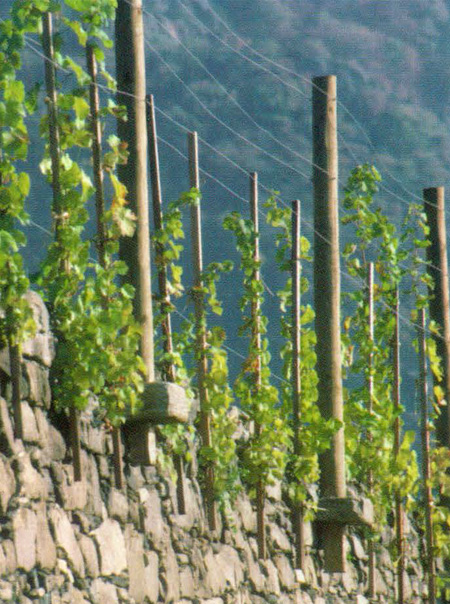
The vicissitudes of weather, particularly during the Little Ice Age of the 14th to 19th centuries, defined a shifting band of viticultural margins, of sites where the grape will ripen—but barely. From a period when vineyards dominated landscapes even in central Britain and the Netherlands, Europe’s viticultural theater gradually retreated during the late Middle Ages to the range of Mosel, Rhine and Danubian vineyards that had coincidentally represented the frontiers of Roman civilization. To capture enough of the sun’s energy demanded the application of architectural vision and backbreaking labor to the steepest, south-facing slopes. Each slope in turn reflected climatic and economic advances and retreats, and 21st century evidence visible even to a speeding, wine-loving motorist, testifies to a long-term retreat.
Many are the formerly renowned slopes—now overgrown with trees or scrub—on which it has in the course of the 20th century become unprofitable to grow any grapes at all, much less late-ripening riesling, and on which to do so always demanded a surplus of energy and luck. This shrinkage appears to call into question the future for steep-slope family viticulture. And yet, the tide may be turning. At the margins of vineyard and woods, in the hardscrabble stone and nosebleed fringes of Europe’s ancient vinous amphitheaters, a handful of growers are waging an insurgency, reclaiming ancient sites, terraces and vines. The effects of their efforts are as yet too minute to catch the eye of the motorist, but take a closer look and you may just be staring into the future of post-industrial fine wine farming.
In 1988, Weissenkirchen vintner Toni Bodenstein and his wife, Ilse, inherited the estate of her father, Franz Prager, whose acreage the young couple had already assisted in raising to considerable notoriety. Their vineyards traverse prehistoric eras and range from primary volcanic soils through metamorphic and recombinatory geological cycles. Walls and terraces are needed here just to hold back the eroded material that gives vine roots their mineral rich but otherwise nutrient poor medium. Each generation of rock provides its own unique environment for vine roots, and there are few estates where the effects of terroir can be more starkly tasted than at Weingut Prager. Rare, too, are winemakers as articulate and scientifically sophisticated in their defense of terroir as Toni Bodenstein. With the Prager dowry came two and a half acres in the Hinterseiber. This south- and southwest-facing site ascends to more than 1,300 feet, higher than Weissenkirchen’s Kaiserberg (from which Charlemagne in 794 surveyed his troops and vines), and towering above the meandering “Ritzling” brook which, at least according to some historians, gave its name to the world’s greatest white grape. Even though planted with the easy-ripening Müller-Thurgau, this parcel merely produced a thin, light wine.
Bodenstein took his Hinterseiber as a challenge. It was simply unacceptable to have lowly Müller-Thurgau on his estate: Such a unique site demanded riesling. Father-in-law Prager was less optimistic. “The only thing riesling grown there is going to be good for,” he predicted, “is as ersatz buckshot.” That dismissive attitude merely stiffened Bodenstein’s resolve. Measured in altitude, the accepted margins of viticulture in the Wachau—along the Danube just west of Krems—lie at around 1,100 feet. But vestiges of ancient terraces running off into the woods and scrub testified to a time when the expanse of Wachau vineyards peaked (in the 16th century) at nearly 10,000 acres, or close to three rimes what it is today. Here was the perfect challenge for an ambitious vintner with a passion for both history and geology. Bodenstein was at once exploring the past and testing his and his vineyard ‘s future limits. The uniquely mica-rich gneiss rock was largely bare of topsoil. Its broken fragments, washed clown into the Ritzling, were known locally as “cat’s gold ,” and what shimmers in the light, Bodenstein reasoned, will trap the sun and render gold in the glass. “If I had an ideal,” he explains, “it stemmed from my enthusiasm for Mosel wine, whose fineness and elegance I admire and whose preconditions seemed nor unlike those in this inevitably late-ripening site.” Thoughts of climate change had not yet crossed the vintner’s mind.
Bodenstein planted with scrupulous care. With the advice of leading vintners and of English wine writer and riesling acolyte Stuart Pigott, he collected ten different Austrian and German clones to supplement vines selected from his oldest and best vineyards in the grand cru sites of Klaus and Achleiren. Into the rocky ground they went—on three sorts of rootstock—in the spring of 1990. Results were at first depressingly unpropitious. The site was hammered by heat and drought in 1992 and 1994, and when the young vines finally set a crop, it seemed to confirm Prager’s prediction of buckshot riesling berries. At last, in 1997, there was sufficient fruit to vinify, and the wine was baptized “Wachsrum Toni Bodenstein,” or “Toni Bodenstein’s Growth.” After all, not only was this the vintner’s pet project, the name “Hinterseiber” was both obscure and awkward. The first commercially significant bottling was in 1999, an Auslese-like elixir harvested late from one cluster per vine. Already, the Wachsrum Toni Bodenstein was exhibiting a distinctive and elegant profile, with spice, flowers and honeyed richness playing against stony minerality. Made from young vines and an untested site, these wines were holding their own in the company of Bodenstein’s celebrated rieslings from Klaus and Achleiren. Ravaged by hail in 2001, the vines that year nevertheless rewarded Bodenstein with a refined and ethereal elixir from tiny, wind-beaten and late-harvested berries.
Only as the achievements of his “Wachstum” mounted and earned a place at the apex of the estate’s price list did Bodenstein reflect on the sources of his new site’s success. Due to its elevation, the site should, in theory, have remained a good ten degrees Oechsle behind Klaus or Achleiten, but the quickly warming stone and late (November) harvest were able to compensate for this seeming handicap. It gradually dawned on Bodenstein that “this site took advantage of climatic warming. From 1990 to 1999 alone, we experienced a twenty percent increase in ultraviolet rays at our latitude, combined with a significant increase in ozone levels near ground level. The risk of late harvest that one might have viewed as a disadvantage appeared on closer inspection to be anything but! The shifting of the critical ripening phase during such warm years into the cooler temperatures of late autumn revealed itself as a major advantage. Cooler temperatures at harvest meant no rot, maximal aromatic development and better acid structure.” Furthermore, the wide day-night temperature swings generally taken by Wachau vintners to be a source of their wines” aromatic and phenolic intensity are all the more pronounced at high altitude. The way Bodenstein puts it, the grape assimilates by day, then holds on to its flavors without backsliding at night.
Wachstum Toni Bodenstein continues to demand an extra measure of effort—750 to 800 man-hours annually—including a severe green harvest. But the price of a bottle is not what justifies the labor. As he says, it’s the positive signal sent by such a wine and its image-building role. The abandonment or abuse of other high elevation locations saddens him yet nurtures hope that far-sighted colleagues will take up the challenge of their times and of warmer climes. Building on a very old and genetically diverse parcel of grüner veltliner which he recently acquired in the Achleiren, Bodenstein has created what he calls his “Noah’s Ark” for vines that will eventually support his and other growers’ attempts to go back to the future.
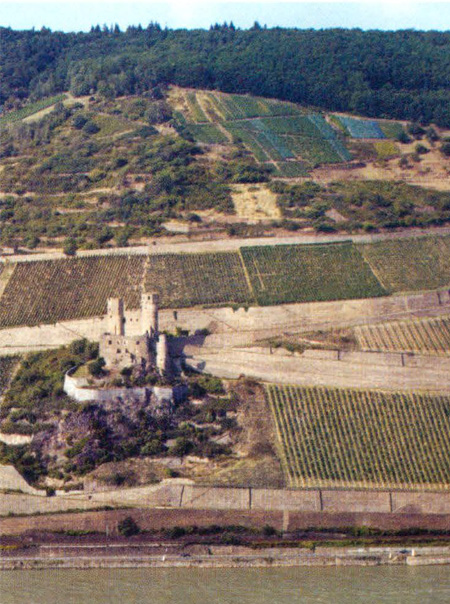
Germany’s late 20th century economic boom coincided with a dramatic decline in vine acreage, particularly on steep slopes daunting to a farming family’s bottom line. The Rheingau’s Rüdesheimer Berg, however, largely maintained its land value and was held tightly by residents. Not only did this location have a history of yielding some of the world’s top rieslings—other steep sites that could make the same claim fell into disuse—but it was also a tourist mecca. The Ehrenfels castle, the Medieval toll-collecting Mouse Tower and Germania—the gargantuan bronze and stone monument to German unification—drew visitors from around the world to the picturesque confluence of the Nahe and Rhein. In consequence, the town itself flourished. Its economy favored small shop-and tavern-keepers like the Leitz family, who sold virtually its entire wine production to the thirsty crowds that milled about Rüdesheim ‘s narrow streets.
High above Rüdesheim’s Berg Schlossberg was one vineyard that failed to share in the region’s good fortune. The Kaisersreinfels (literally “emperor’s stone cliff”) had last flourished in the 19th century, when vintners drawn from other regions of Germany by Rüdesheim’s reputation were directed to plant there. They rebuilt its ancient terraces and struggled to ripen riesling on this stony quatrzitic ground, doubtless all the while waiting and hoping to make inroads into the Schloßberg below, or to put a down payment in sweat on a piece of the nearby Berg Rotcland or Berg Roseneck. From the ‘60s on, in a massive series of public works projects known as Flurbereinigung, the majority of Germany’s steep vineyards were torn up and then painstakingly reconstructed with broader terraces, paved roadways, concrete buttresses and consolidated ownership. Few doubted that this reconstruction would alter the character of the wines, not only on account of young vines but because of a genuine disturbance of the vinous environment. For many communities and vintners, though, the alternatives—narrow stone terraces accessible only by foot and acreage subdivided into hundreds of isolated plots or individual rows—were simply economically unsustainable. When Flurbereinigung came to prosperous Rüdesheim, the Kaisersteinfels was left behind, its steep ledges by then deemed unworthy of consideration.
When he was 14, Johannes Leitz’s father—whom he had already helped in the vineyards since the age of ten—suddenly died. While his mother continued to run the family dispensary, Johannes found himself a professional vintner. “After school, I had to go to the vineyards and leave my homework for later,” he relates. It is a fate he does not regret. “Vineyard work is the sort of thing you can only learn by doing. You can’t learn it in school. Maybe it sounds arrogant, but I think there is no one else in his mid-thirties who knew as much about vineyards and vines as I did. And when I took over in 1985, there was no money to invest in technology—stainless steel, air conditioners, cooling jackets, filters—so I had to work the old way. I came to realize that one hundred percent of quality comes from the vines and you just have to steer that quality into the cellar.”
The ancient methods of winemaking preoccupied young Leitz, as did the ancient terraces of the Kaisersteinfels. “As a child I worked in these terraces,” he explains, a portion of which were rented by family members. “The vines were old already back then. I estimate they’re eighty years old now at least. They don’t look so great. In fact, they look wizened, bent over and weak like old men—which is just what you’d expect. What inspired me about this place was the potential to make Rüdesheim wine the way it used to be, from old vines in unreconstructed stone terraces, in other words, the original terroir. This soil has remained undisturbed, and no earth was ever moved in from outside.”
From the late ‘80s on, young Leitz’s reputation soared . His collaboration with American importer Terry Theise helped make possible a significant expansion of the family holdings. This new acreage informed a range of subtly sweet and minerally distinct wines from sites marginally less steep and decidedly less prestigious than those of the Rüdesheimer Berg, yet—in Leitz’s hands—consistently exceptional in quality. Even though the majority of production was exported to the US, Leitz’s full-bodied, dry, lees-enriched representations of riesling from the slate and quartzite of the Rüdesheimer Berg began to attract a cult following in Europe. One day in 2000, “we were sitting in the US, and [Terry Theise’s right hand man] Kevin Pike was saying how his dream was to own a vineyard in the Nahe.” The inspiration for this notion, Pike explained, was the riesling of Dönnhoff. “I was a little jealous, frankly,” says Leitz. Soon after he returned home, he learned that 2,000 square meters of Kaisersreinfels were for sale by an owner who had been selling off his crop in bulk. “So I thought, I’ll buy the Kaisersreinfels and then sell it to Kevin.”’ Their unorthodox arrangement left Pike economically and emotionally invested in Rüdesheim and Weingut Leitz, while leaving Leitz at liberty to pursue his own dream of Rüdesheim Riesling as it used to be.
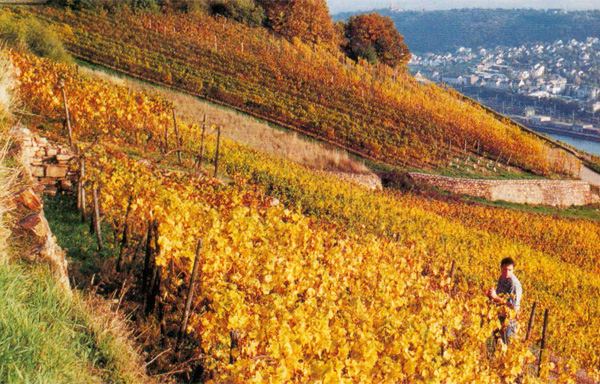
The glorious results from 2001 on—dry Spätlesen possessed of haunting piquancy and strikingly salty, lip-smacking length—instantly exceeded Leitz’s expectations. Like Toni Bodenstein in the Wachau, Leitz began to reflect on the reasons for his success once the evidence of that success was literally under his nose. Perhaps the late 20th-century neglect of the Kaisersreinfels had not been entirely unjustified. “Thirty years ago, this could not have been considered as good a site as the Schloßberg. In principle, this site is too high up and too near the woods. But the climate has been changing and since 1988 we have warmer and warmer vintages.” In vineyards noted for their ability to ripen riesling even in weak years, Rüdesheim’s vintners were increasingly confronted with a surplus of sugar, particularly as most of them were focusing on dry wines. Alcohol levels thus relentlessly increased. As Leitz puts it, “Although I don’t wish to take anything away from the quality of our best rieslings, they are coming more and more to resemble the bigger-bodied wines of the Pfalz or the Wachau.” Against this background, the Kaisersreinfels project isn’t just about ancient vines and terraces, but also more recently abandoned norms. While Leitz’s dry wines from this site have also copped 13 percent alcohol, their mineral and phenolic intricacy and lively acid retention make for wines of elegance and vivacity. Like Bodenstein, Leitz thinks that extreme diurnal temperature variation and the ability—which in another context or earlier time would be viewed as need—to let the fruit hang, all work to the advantage of his Kaisersreinfels rieslings.
In freakishly warm 2003, the dry wine from this site evinced an invigorating brightness virtually unknown in that vintage, and a portion of the crop was picked our early as a spectacular Trockenbeerenauslese. Still, barring such exceptional circumstances, Leitz plans to hold his stylistic course: The Kaisersreinfels rieslings will be dry-tasting even if not always analytically dry. He was able to acquire a second, contiguous parcel, and last year leased the most promising portion of what remains. This means that in the 2005 vintage, production will reach a level where, at last, a significant number of riesling lovers on both sides of the Atlantic can latch on to a bottle of Kaisersreinfels and confirm Leitz’s observation. “Something’s up with the climate, but whatever it is, it’s working to our advantage in this site.”
Something is up else where a long the Mosel, Rhine and Danube as well. In the Mittelrhein, the steeply terraced Engelstein between Boppard and Spay was ignored during Flurbereinigung not least because cherry trees planted there in the 1920s were a surer source of income than vines. Ripping out the orchard in 2001, Florian Weingart replanted over vestiges of ancient vines. “This is actually one of the warmest spars in Boppard,” he explains, and proudly presents from barrel his promising first crop—of pinor noir! As it bends toward Spay, though, the Engelstein turns away from direct sun. Yet Weingart was happy to acquire that portion as well. “As a consequence of climate change, it could become interesting,” he maintains, no doubt reminded of the precipitous Schloß Fürsrenberg vineyard in a cool side valley near Bacharach. Rented to generate Q.b.A. and base wines for Sekt, it now routinely rewards Weingart with superb riesling Spätlesen.
For other examples, look to the recent plantings in the wind-exposed upper reaches of the Haardter Bürgergarten. Located in Germany’s driest and warmest region, the Pfalz, this site was better known for its commanding view than for its vines until Heinrich Catoir and Müller-Catoir cellar master Hans-Günter Schwarz championed it. Then there’s the city-owned winery of Krems on Austria’s Danube, grooming high terraces in the Grillenparz—long left to the crickets for which it is named—for its future flagship. For every one of these visionaries, there are surely a dozen neighbors who look up and roll their eyes. Some of them—and us—may live to taste the wines, and to find out who has the last laugh in the game with nature. Human nature, after all, is crazy too.

David Schildknecht has followed German wines for several decades, both as a wine buyer at Vintner Select and as a longtime writer for publications including Wine & Spirits, The World of Fine Wine and Austria’s Vinaria.
This story appears in the print issue of April 2006.
Like what you read? Subscribe today.