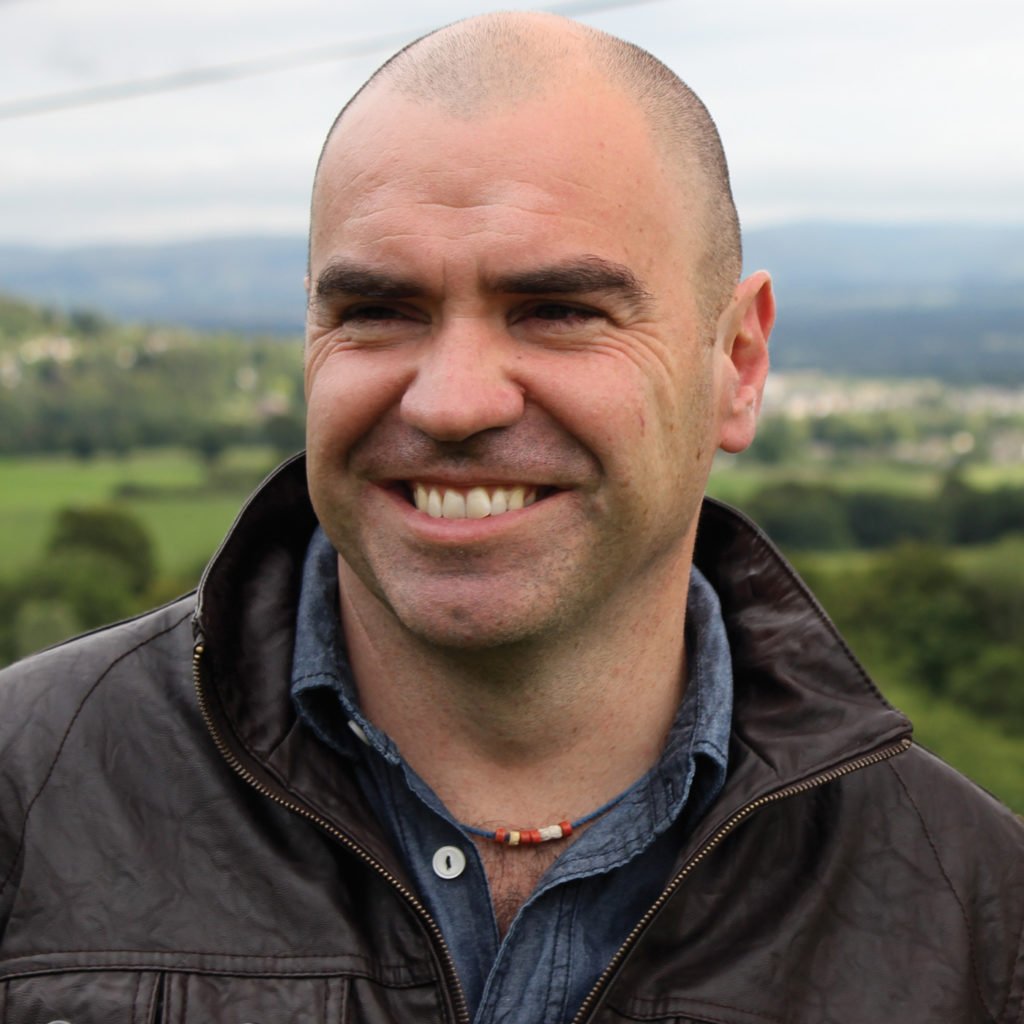
“This was not an easy vintage,” says Louis-Michel Liger-Belair, standing by the low stone wall of La Romanée. Above the next wall, at the top of the hill, is Reignots. Both properties have been in his family’s hands since 1815.
The business of being an aristocrat has changed in 200 years, and Louis-Michel is the first comte to work as the enologist in the cellars of the Château de Vosne for the Domaine Comte Liger-Belair. His ancient vines—one-third of the population at La Romanée and Reignots is more than 90 years old—combine with his youthful enthusiasm to make a challenging year like 2014 seem grand.
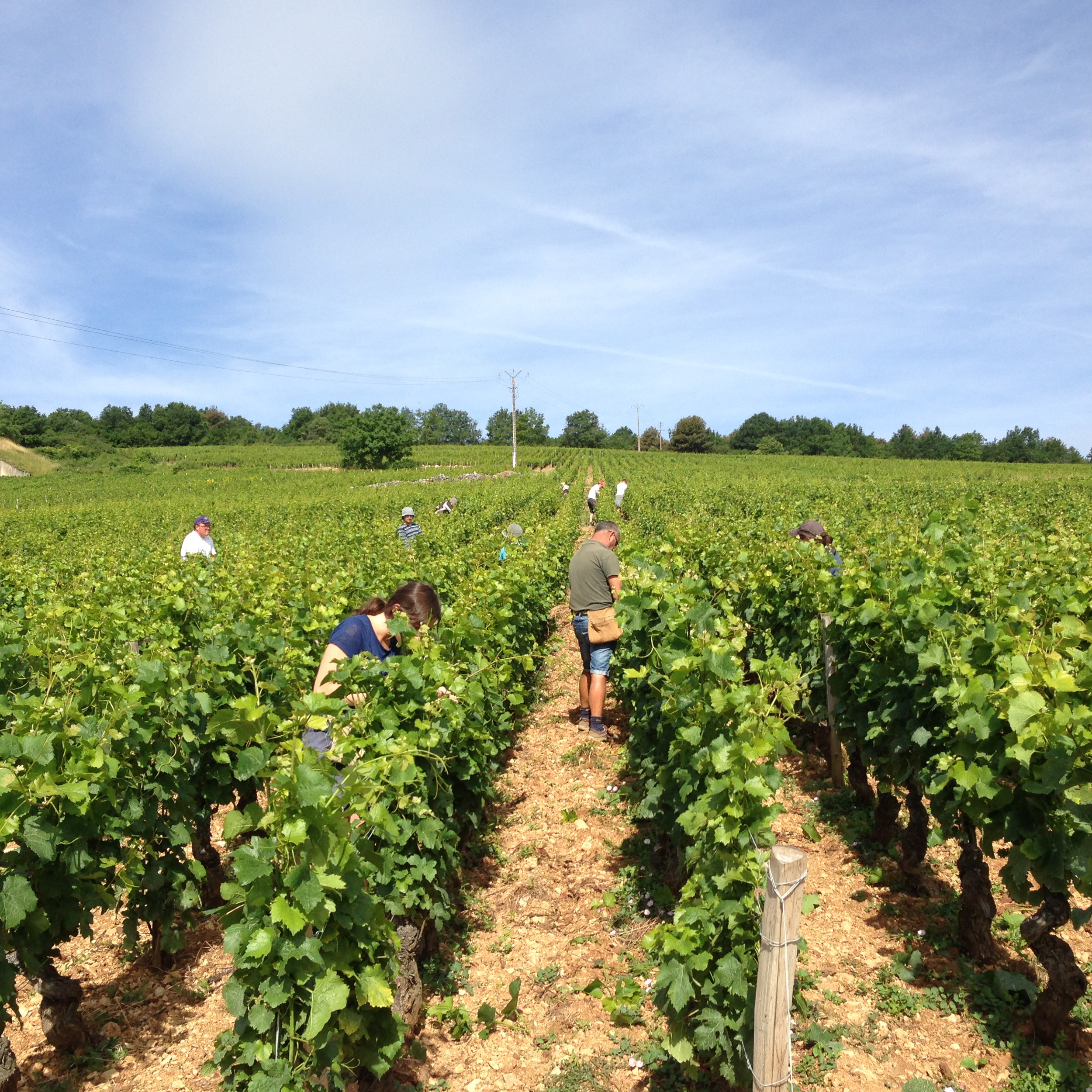
A vintage marked by hail in June, rain in summer and cool weather in August, 2014 caused its share of angst in Burgundy. Quantities are down; prices are not. The global fine wine market has focused more attention on Burgundy than ever in the last few vintages, and there is not a lot of wine to go around. Still, my impression, after visiting some of the most talented vines, vineyards and vignerons in Burgundy’s Côte de Nuits, is that farming practices are creating a widening gap in quality. The vignerons who farm brilliantly produced terrific wines in 2014 (if they were not wiped out by hail); those who make wines, rather than grow them, may have performed less well.
“Since 2009, we haven’t had an easy vintage,” Liger-Belair says. “In 2014, the ripeness came late.” For Liger-Belair, who reestablished his family’s domaine starting in 2000, and now farms 21.5 acres, quantity is down 15 percent from the norm. “There was hail on June 28th,” he says, “just in the premiers and grands crus.” That, in itself, took out between five and ten percent of the crop, but he says it was early enough in the season that the wines do not have a “hail taste”—the bitterness that comes when vine leaves are shredded by hail and the plants then struggle with photosynthesis.
The hail had come after an early, optimistic start to the vintage. The first setback was cool, wet weather that delayed flowering. Then June came on warm and dry, lifting the spirits of growers until the 28th, when thunderstorms and hail devastated vineyards in the Côte de Beaune. Santenay, Meursault, Pommard and Volnay were especially hard hit. July was rainy and warm, August rainy and cool, and it wasn’t until a sustained period of fine weather carried through September that optimism began to grow. The weather held, and the ripening of the grapes under cool autumn conditions marks the character of the 2014 wines.
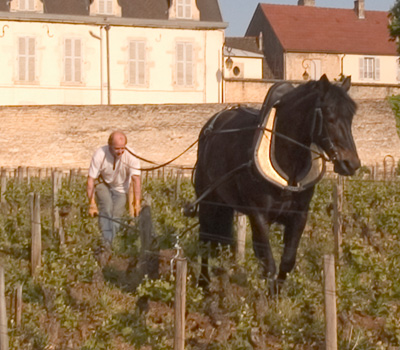
All the rain in summer meant soil conditions were critical. Clearly, some soils drain better than others, but soils that are dead and compacted do not provide the best environment for a vine through a rainy August. As we climb from La Romanée to cross the road and enter Reignots, Liger-Belair is talking about plowing. He has used a horse since 2002, believing tractors compact the soil too heavily, while a horse’s hooves make a more random and varied impression as it strides up a row. Liger-Belair’s farming employs many of the principles of organics, but he takes a pragmatic approach to his vines, preferring to minimize the number of sprays that would be necessary under organics. He fears too much copper accumulating in his soils; his team uses powdered sulfur, rather than copper sulfate, when necessary. Down the hill, at the Clos du Château, Liger-Belair is experimenting with a small block of vines farmed in alternating rows under organics and biodynamics. He vinified these grapes separately in 2014. In his cellar, down a stairway from the courtyard of the château, he offers a taste of each. The organically grown vines provide a gentle, rich red; the wine from the biodynamic vines is, well, more dynamic, with finer tannins and more detail in the flavor. It shows the vintage character of freshness with a high pH. There was no heat to turn the soft wines of 2014 into jam; instead, the cool conditions during ripening helped accommodate their gentleness.
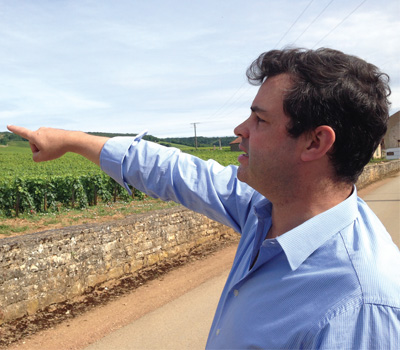
Ripeness came late in 2014. We might not have had a ripe vintage if our quantities had not been down by fifteen or twenty percent.
—Louis-Michel Liger-Belair
Liger-Belair is no less concerned about the life of his vines and his soils than many advocates of biodynamics.He considers the life of the microbes on the grape skins that come into his cellar, and the life of the yeasts that ferment his wines, adding only a small dose of sulfur before letting his wines soak for a week in the cold, then allowing the yeasts to warm up and start their work.
He picks ripe and brings plenty of oxygen to his must through pump-overs, but he minimizes extraction, his purpose to get as much beneficial digestive activity out of the microbial life as possible, not to get too much weight out of the material itself.
Even so, he gets a lot of power out of his ancient vines up the hill at Reignots. “There are more tannins in Reignots than in any other wine we make,” he explains, describing the “pomme de pin” selection of vines that populate the vineyard, their bunches shaped like pine cones,
their berries particularly small. Out of cask, the 2014 is bright, intense without any weight. It offers a taste of the earth veiled by a taste of fresh plums perked up by the sparkle of tannins where all the energy of the wine is vested. “To have a grand cru in Burgundy, you need to have the perfect level of clay, the perfect level of limestone and the perfect size of the stone. The Reignots soils are more rocky, with about the same level of limestone and clay as La Romanée. But the stones are too big to be a grand cru.”
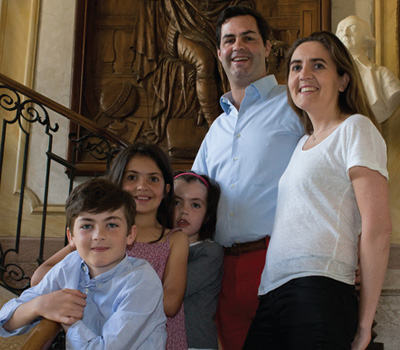
As he thieves a taste of the 2014 La Romanée, Liger-Belair explains that they changed to a small vertical press in 2009. “We select much more than in the past,” he says. That stricter selection, along with the gentleness of the press, allows him to add the press wine in without building aggressive tannins. “We have a bit longer post-fermentation maceration,” as he finds he prefers the taste of the wine with that longer finishing time. In fact, there is no apparent ending to the taste of La Romanée, the wine cool, spicy, ethereal. And it just keeps going on.
Liger-Belair inherited his title this year, upon the death of his father in February. It’s very 21st century to meet a French count who is so technically involved in the work of making and selling wine; perhaps because of his position, he has taken on the challenge of his role with a fierce determination, applying the mind of an agricultural engineer and philosopher to some of the most coveted vineyard land in the world. His wines do not seem forced. Especially in a difficult season like 2014, the grace of the vineyards shines through.
It’s possible to still taste La Romanée as I drive north, past Clos Vougeot, toward Chambolle, to meet Louis Boillot and Ghislaine Barthod, he of the Volnay Boillots, she of the Chambolle Barthods, each working their own domaine in adjacent cellars.
Boillot’s domaine includes sites in Volnay and Pommard, as well as Nuits-St-Georges and Gevrey, predominantly. His take on 2014 is marked by the recollection of 80 percent hail damage in Pommard. “They took out the forest behind the vineyards, so there is no protection,” he says. His 2014 Gevreys are dense, especially the Cherbaudes, from 100-year old vines in a cru just below Mazis. “The ripeness of old vines is a much more balanced maturity than in a younger vine,” he says. “The sugars rise more slowly; the acidity drops more slowly. It’s a wiser maturation.”
As we taste his Nuits-St-Georges Pruliers, also from ancient vines, he recalls how he left his cellar in Gevrey in 2002 to join Barthod—how he concentrated on making his wines finer, a Chambollification of his Gevrey crus. There’s crispness to his 2014s, a combination of slightly exotic ripeness and freshness.
Barthod and Boillot’s son, Clément, joins us as we duck through a series of doorways and down a few stairs to Barthod’s cellar. Clément is in line to inherit both domaines. Built like a basketball star, well north of six and a half feet tall, the lanky teen is headed to Calera to work harvest with Josh Jensen. Standing by Barthod’s barrels, he towers over his mother and makes her seem almost diminutive, even with all her energy and spunk. Having worked with her father through the 1980s, Barthod went on to take this small family domaine to a higher level through pruning for tighter yields, and greater care throughout the selection and winemaking.
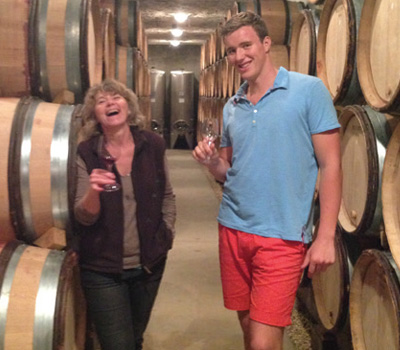
Barthod has no grands crus; the attention she focuses on her nine Chambolle premiers crus takes them out of Burgundy’s hierarchical world, with each cru given equal weight to speak of the vintage. She leads us from Beaux Bruns, a fleshy wine from 65-year-old vines lower on the slope, up to Les Bardes, a site just below Bonnes Mares, with the beeswax depth of a wine close to Morey.
One standout in her cellar is Charmes, a structured, lovely, black-fruited Chambolle with bright richness from 70-year-old vines. Another is Fuées, from vines of the same age on red soil, with its crunchy fruit and silky originality, the tannins singular and precise.
Barthod describes Véroilles as “a little basin on terres blanches just above Bonnes Mares, twenty seven acres of premier cru in a village lieu-dit, just this little square. My father asked for premier cru classification—it’s a monopole.” And it lives up to the status with a powerful, mineral density, its flavors seeming to arrive from all sides of the mouth.
And then there’s Les Cras, a premier cru close to the village where the soil gets poorer as the vines get closer to the center of town. The 2014 has a convoluted freshness, the wine in motion, kinetic and energized, with chewy muscle and depth of fragrance. “After ten years, Les Cras keeps the energy,” Barthod says, and it’s hard not to think she has infused some of her own energy into this wine. Even so, Barthod prefers her Chambolle crus from 2013, which she considers “a year for the pinot. We like the cold years for pinot noir,” she says. “The wines are always more precise.”
Back in the center of town, Delphine Roumier meets me at the small office of her family’s domaine and calls her brother, Christophe, on his mobile. I was curious to visit Roumier, as I have been drinking his Chambolle-Musigny since the 1980s. It was affordable at the time, maybe $30 a bottle at retail, and it became my favorite village Burgundy—one I preferred to premier cru wines from many other producers. I had met Roumier at a number of tastings, but never in Chambolle.
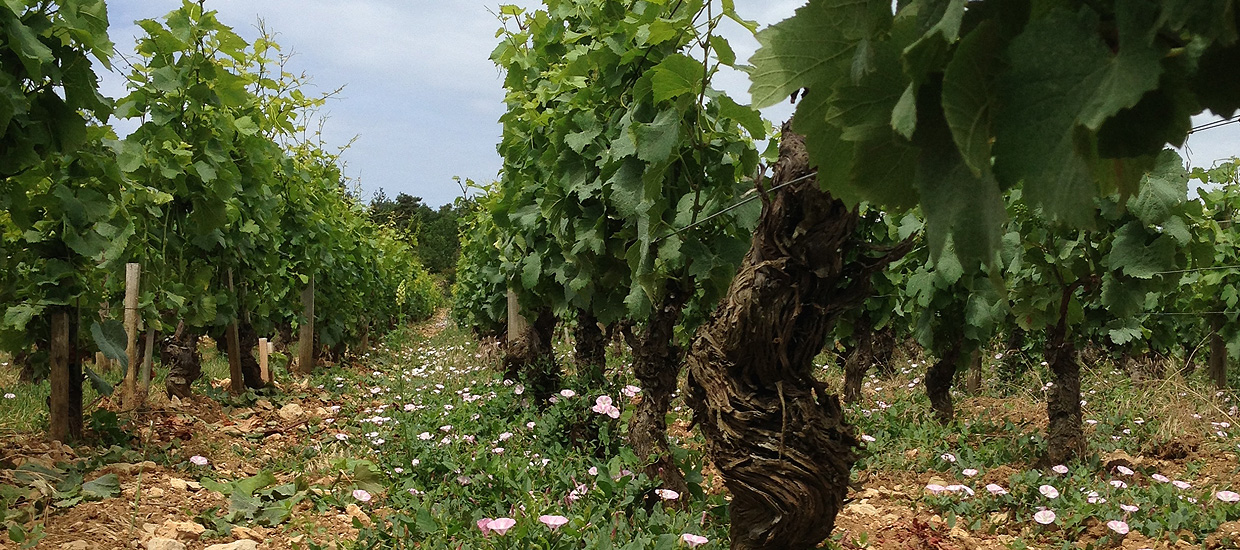
When Roumier arrives at the office, I ask if we can start in the vineyards. We begin with Les Amoureuses, where he explains, in his clipped and emphatic way, how he started working at the domaine. “I started with my father in 1981,” he says, “1984 was my first winemaking vintage.” He stopped using weed killer at the domaine in 1989 and farms the vineyards under organics, but he is not certified. He points out the sectors of Amoureuses planted in 1928, 1962, 1974, and four rows planted in 1989. “The limestone is more fractured here than in Musigny, where it is kept more together,” Roumier says.
We walk up the hill and stop. “My Musigny starts here,” he says. “Nine rows, up to the top of the hill.” It’s a total of 0.30 acres, the earliest vines planted in 1905, “but there is very little of that left,” he admits. “I like the shape of the bunches here, the very small berries. In the grand cru vineyards, we do not replant by block, we just replant vine by vine.”
As we walk to the top of Musigny, Roumier explains that his intentions have changed over time. “In the nineteen-eighties, people were asking for more color in the wines,” he says. “I was like that in the end of the eighties. Now I prefer to have wines that are lighter in body. I accept lighter colors as well. And I have always resisted the fashion for new oak. The village wine sees less than twenty percent new oak. The rest see between twenty and thirty percent. That’s been consistent from the beginning. I try to do the wines the way I like them, but there is a big parameter—that is the vintage—that makes its own way.”
Across town, at Bonnes Mares, Roumier points out the blocks in red soil, with vines that date to the 1930s, to 1974 and 1989. There are gray marl soils above and to the south, where his oldest vines date to 1947. “The red soil is more vigorous,” he finds. “Maybe to have two different types of soils on the same appellation is what makes Bonnes Mares special.” It is a significant holding, with 3.95 acres out of a total of 29.2 in the domaine overall. Looking down the hill to the east from Bonnes Mares, he points out the Clos de la Bussière, where his mother and sister live in the midst of a vineyard established by monks in the 12th century.
Back at the cellar in town, Roumier leads me through barrels of 2014, starting with the Chambolle-Musigny. It’s a blend from a range of plots, mostly hillside vineyards (more than two-thirds of the domaine’s vines are on hillsides, he points out). It’s a tight, muscular, fresh, friendly Chambolle, with a reverberation that’s not present in most village wines. His Bussière is texturally deep, darker in fruit than the Chambolle. He describes it as having a “meaty tannic structure, definitely darker. I like Morey wines,” he says.
Roumier goes next to a barrel of Les Cras, where he finds a mineral, chalky texture, “almost salted.” I find it floral and tense. While the Morey wine was round and full, like puffing out my cheeks in a French shrug, this draws in my cheeks. It has the marker of Chambolle—that rose-thorn prick of acidity and the silken gentleness to soothe it.
He offers a taste of a massive and detailed Ruchottes-Chambertin and a gentle, red-fruited Charmes-Chambertin—the latter from a parcel in Mazoyères; both are from vineyards he is renting, the wines bottled under his own label, Christophe Roumier. Then he goes to Bonnes Mares, a round wine with graceful, firm tannins. The shape of the wine does not seem to belong to Chambolle, instead looking north, to Morey.
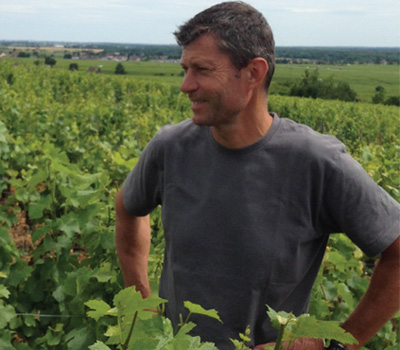
I try to do the wines the way I like them, but there is a big parameter—that is the vintage—that makes its own way.
—Christophe Roumier
The shape is clearly Chambolle when we go to Amoureuses, with its crisp, bright detail in the tannins. Here, it’s the tannins that last. “It’s intense and weightless, which is an interesting combination,” Roumier says, then he goes on to consider the vintage.
“In the end of September, beginning of October, there is always a risk of botrytis. Conditions were such that we could fear botrytis, but we did not have it. Finally, we had enough good light to ripen the tannins. Acidity is a little lower than we should wish in some of the wines. The rains did not bring dilution, but brought the pH a little higher. [As Roumier explains, the rain causes the vines to take up more calcium and potassium, which migrates to the must and buffers acidity down.] Two thousand-fourteen is probably not designed for the long term; it’s probably a good vintage for ten years of aging. No more than that. The serious wine lovers like their wines with some majority,” he added, as he drew some Musigny from his tiny barrel-and-a-half supply. “The acidity level is not that strong so the wines are easy. The exuberance of the fruit—I have a feeling this vintage is good because it is fruit-full.”
Roumier’s Musigny is the most fragrant of the wines, scented in rose and layers of limestone earth, its power tied to its freshness, not tense, but buoyant. There is a hierarchy to Roumier’s wines, an orderly progression to his cellar that I have rarely experienced as clearly as here. He has worked in this cellar for more than 30 years, and yet he still seems surprised by the wines. It was a pleasant sort of surprise in 2014. Roumier’s wines describe their origins with remarkable clarity, but they are not academic studies in terroir. They are seductive pleasures of the earth.

Joshua Greene is the editor and publisher of Wine & Spirits magazine.
This story appears in the print issue
of October 2015.
Like what you read? Subscribe
today.