
Ten years ago, when great Greek wine was beginning to hit these shores, you’d have to go to New York to get the full experience. An all-Greek wine list was something you could pull off only in a city where being outrageous is a positive attribute, and competition is fierce when it comes to pouring something your neighbor hasn’t already discovered.
Today, one of the largest Greek wine lists in the US is in Houston, Texas, second only to Kamal Kouiri’s at Molyvos in NYC—which is arguably the deepest in the world. Another standout has taken shape in Vermont, virgin territory for Greek wine, as was Seattle, now becoming a hub for Greek winemakers thanks to Omega’s extensive list.
What’s changed? There’s the economic crisis in Greece, which has pushed winemakers to focus on outside markets. But there’s also a more essential change here in the States. While there are still plenty of diner cooks slinging four inch-high bricks of spanakopita (and they can be delicious)—as well as chefs at glittering cathedrals of seafood and high-concept Greek food—a new crop of restaurateurs is presenting an alternate path that’s truer to the food in Greece than anything we’ve experienced on this side of the Atlantic.
This is the third wave: chefs and restaurateurs who consider Greek wine and food together, as naturally as it happens at home in Thessaloniki or Sparta.

Taverna Khione
In 2008, Marc Provencher landed a job opening Emilitsa, an upscale Greek restaurant in Portland, Maine. Although his mother is first generation Greek-American, he’d grown up nearby in Falmouth, and it was the first time he’d really been exposed to Greek food. He took to it immediately: “I just like the simplicity of Greek cuisine,” he says.
He soon began wondering why Greek food remained underappreciated. “While there’s fine dining in Italian, Spanish and French food, Greek has always been more lowbrow,” he says. “I think it’s the diner nature: They’ve dumbed down some of the cuisine—spanakopita, gyros, Greek salads. People didn’t know there was a whole other world to Greek cuisine.” Meanwhile, he’d heard about Kefi, where Michael Psilakis was serving traditional Greek taverna food alongside an all-Greek wine list, and getting raves. “I figured, if he was able to do it there, why can’t we do it a little farther north?” So when he moved to Shelburne, Vermont, he decided to try—even though there wasn’t a single Greek wine in the state. Now he has more than 50 at Taverna Khione, which he opened in April 2015, naming it after the goddess of snow.

“I just don’t see the sense in serving California wine with Greek food.”
—Marc Provencher
“The whole process of getting the importers in here; it was something,” he says, “but I just don’t see the sense in serving California wine with Greek food.” Especially his style of Greek cuisine: Talk to him, and you’d think he’d grown up on a remote Greek island where the only ingredients were those he could forage in the surrounding hills. Ask for moussaka here and you’re out of luck unless it’s August—when the eggplants finally ripen in Vermont, and the tomatoes are at their juiciest and most flavorful.
This spring, one of his favorite dishes was braised goat: “We get whole goats in, break them down, braise the meat in white wine and lemon juice—and fennel, being that it’s in season—and serve it with trahana,” he says, referring to a Greek starch made from wheat and soured milk. “That’s it. Five ingredients. That’s the approach we take: Our hands are tied; we’re not putting any twists on it; it’s what you’d get in your grandmother’s village.”
There’s more to transmitting the “Greekness” of a dish than just the recipe, though; goat and fennel are pan-Mediterranean ingredients. “It’s eating with the hands, getting really comfortable with the food, that makes the difference,” Provencher says. “It’s the feeling: a liveliness, and a sense of comfort enough that people come in and let loose of whatever’s happening outside with their life.”
Wine is an essential part of that package, too. “Sure, there are some people who are confused; I make sure there are descriptions for each wine on the list, so they can find something that’s similar to what they are used to,” he says. And his wine suggestions sometimes raise eyebrows, like a dry, citrusy moschofilero from Spiropoulos in Mantinia for the braised goat—unusual here in the US where we’re more used to red wine with meat. But it wouldn’t be out of place in Mantinia, especially with the lemony broth. “My thought is,” he says, “let’s make it an experience.”
5573 Shelburne Rd., Shelburne, VT; 802-985-2137, tavernakhione.com
Moussaka
adapted from Marc Provencher, chef/owner at Taverna Khione, Shelburne, VT
Ingredients
Serves 6.
Meat sauce
- 1/2 large yellow onion, diced
- 3 cloves garlic, minced
- 2 tbsp olive oil
- 1 1/2 pounds ground beef
- 1 cup ground/puréed tomatoes
- 1 cup dry red wine
- 1 tbsp cinnamon
- 1/2 tbsp salt
- 1/4 tbsp pepper
Béchamel sauce
- 8 tbsp unsalted butter
- 1/2 cup all-purpose flour
- 4 cup milk, warmed
- 1/2 cup grated myzithra cheese (Parmigiano works as well)
- 2 tsp grated nutmeg
- 1/2 tbsp salt
- 1/4 tbsp pepper
- 4 egg yolks
Instructions
To assemble:
- 9x9 inch pan 2 large Italian, Sicilian or graffiti eggplants (about a pound each) 2 tablespoons olive oil ½ tablespoon salt ¼ tablespoon pepper
For the Meat sauce:
- In a large sauté pan over medium heat, sauté onions and garlic until onions are translucent. Add beef and continue to cook until no longer pink. Carefully drain the fat from the pan. Return to heat and add the tomato purée, wine and cinnamon and simmer for 30 minutes, until thickened. Season with salt and pepper to taste. Reserve until ready to assemble the moussaka. (This can be prepared ahead and refrigerated for 2 to 3 days.)
For the Béchamel sauce:
- In a heavy pot, melt butter on medium heat. Whisk in the flour and continue to cook, stirring with a spoon, until the mixture turns lightly golden. Slowly add the milk while continuing to stir. Once all the milk has been incorporated, add the cheese and nutmeg and bring to a light simmer, all the while stirring so that the sauce does not burn on the bottom. Once it reaches a simmer take the pan off the heat. Whisk the egg yolks in a large heat-proof bowl. Temper them by adding ¼ cup of the hot sauce, stirring vigorously. Slowly stir in the rest of the sauce, then return the mixture to the pot and keep warm. Add salt and pepper to taste.
Assembling:
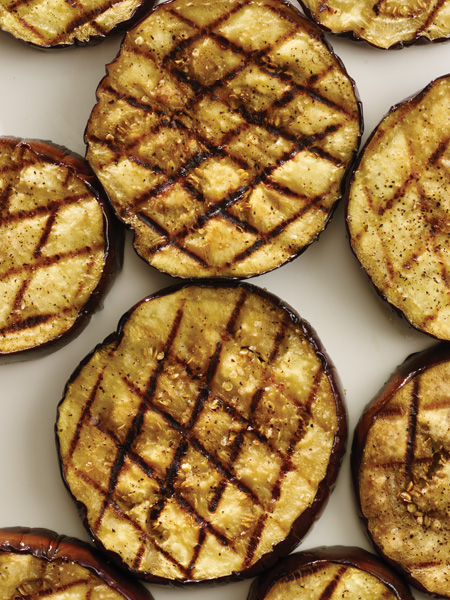
- Preheat oven to 400˚F or use a grill. Cut the top and bottoms off the eggplant and discard. Slice the eggplant into ¼-inch rounds and toss in a bowl with oil, salt and pepper. If using a grill, grill slices for 3 to 4 minutes on each side, until fork tender. If using the oven, roast for 20 to 25 minutes until fully cooked. Place half of the cooked eggplant on the bottom on the 9x9 pan. Spread the meat sauce over the eggplant, then top with the remaining eggplant. Pour the béchamel sauce over and place the pan in the preheated oven. Lower the temperature to 350˚F and bake for 35 to 45 minutes, or until the top of the béchamel begins to turn golden. Remove from oven and let cool for 45 minutes. That way, the béchamel will begin to firm up and make it much easier to serve. Provencher likes to pour a xinomavro from Naoussa alongside, like Thymiopoulos Young Vines.

is W&S’s editor at large and covers the wines of the Mediterranean and Central and Eastern Europe for the magazine.
This story appears in the print issue of August 2016.
Like what you read? Subscribe today.